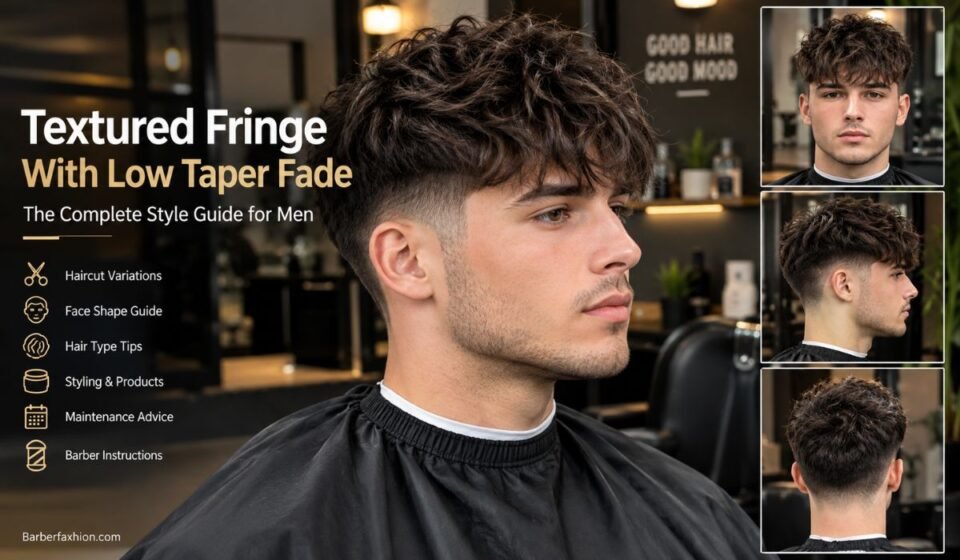

You know that feeling when you want a haircut that looks fresh but doesn’t make you look like you tried too hard? That’s exactly where a textured fringe with low taper fade can work. It keeps the sides clean while leaving enough movement on top to give your hair a relaxed, modern finish.
The best part is that you don’t have to copy one exact version of the cut. Your barber can adjust the fringe length, texture, taper, and overall shape around your hair type and face shape. This guide explains how the style works, which version may suit you, what to tell your barber, and how to style it at home.
Quick Answer: A textured fringe with a low taper fade combines a choppy, layered fringe on top with a subtle taper around the ears, sideburns, and neckline. It’s a versatile men’s haircut that can work with straight, wavy, thick, fine, and curly hair when the cut is adapted to the hair’s natural texture.
What Is a Textured Fringe With a Low Taper Fade?
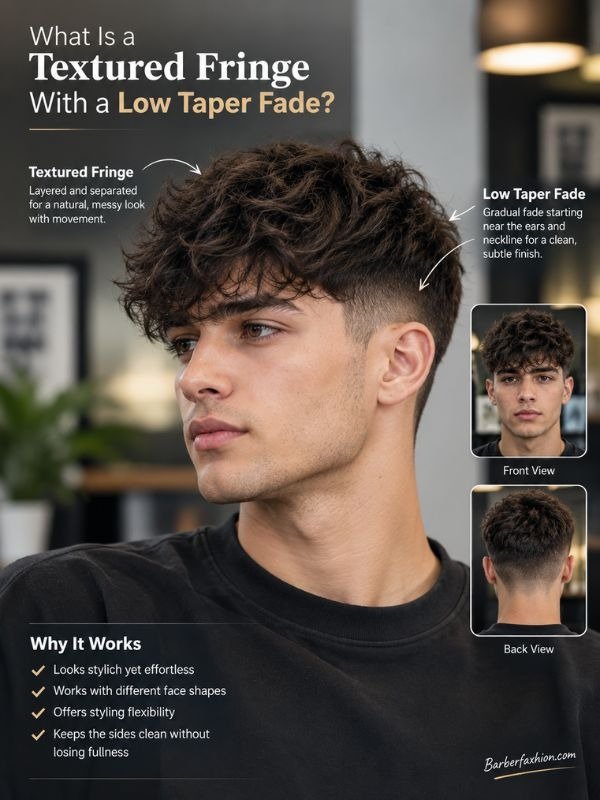
A textured fringe is a forward-cut hairstyle where the hair at the front has separated, uneven-looking pieces rather than one solid, blunt line. The texture gives the fringe movement and prevents it from looking flat or overly neat.
The low taper handles the sides and back differently. Instead of removing hair high up the sides, the taper gradually shortens the hair around the lower sideburns, ears, and neckline. This leaves more fullness around the head while still giving the haircut a clean finish.
Together, these two elements create a useful balance. The fringe gives the haircut personality, while the low taper keeps everything around the edges controlled.
What Makes a Fringe Textured?
Texture is what gives the fringe its broken-up, natural appearance. Your barber may use techniques such as point cutting or careful texturizing to create separation between sections of hair.
The goal isn’t simply to make the hair shorter. It’s to remove or distribute some weight so the strands can sit in different directions.
A good textured fringe should still look like hair rather than a row of perfectly separated spikes.
What Does a Low Taper Actually Mean?
A low taper starts close to the bottom of the sides and back. The transition happens around the sideburns and neckline instead of climbing high toward the temples.
That’s why a low taper usually looks more subtle than a high fade. You keep more of your natural fullness while getting a sharper outline around the edges.
If you want a haircut that looks clean without creating a dramatic contrast between the top and sides, a lower taper fade is worth considering.
Taper vs. Fade vs. Fringe: What’s the Difference?
These terms describe different parts of the haircut.
- Fringe: The hair at the front that falls toward the forehead.
- Taper: A gradual reduction in length around selected areas.
- Fade: A more noticeable blend between different hair lengths, often progressing much shorter toward the skin.
A haircut can combine all three ideas. The fringe describes the top and front, while the taper or fade describes how the sides and back are finished.
Why This Haircut Works So Well
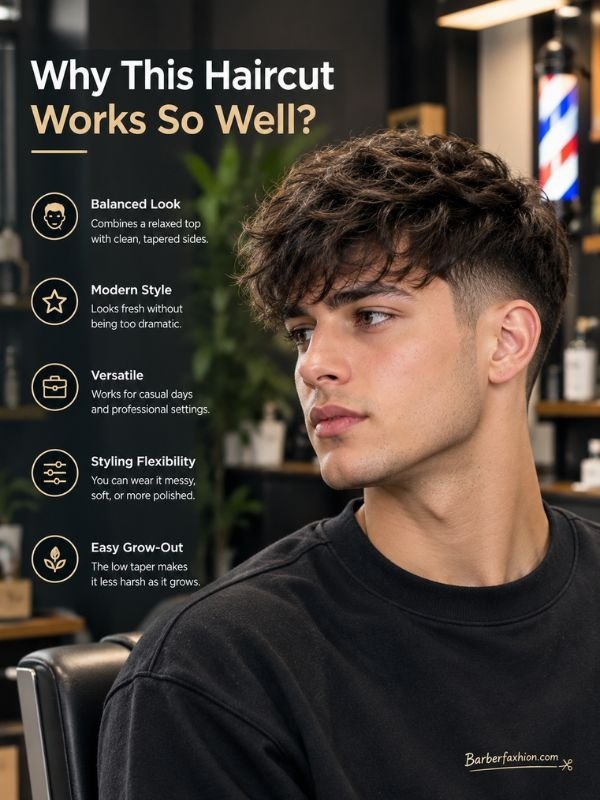
A textured fringe with low taper fade gives you contrast without making the haircut look extreme. The top can be messy, soft, fluffy, or slightly structured, while the lower sides remain neat.
It also gives your barber plenty of room to personalize the shape. Someone with thick straight hair may need weight removed from the top, while someone with fine hair may need texture created without taking away too much density.
Another advantage is styling flexibility. You can wear the fringe forward, slightly to the side, messier, or with more volume depending on your mood and the length your barber leaves.
It’s also a practical option if you don’t want a haircut that looks overly formal. The low taper keeps the edges presentable while the textured top gives it a more relaxed character.
Is a Textured Fringe With Low Taper Fade Right for You?
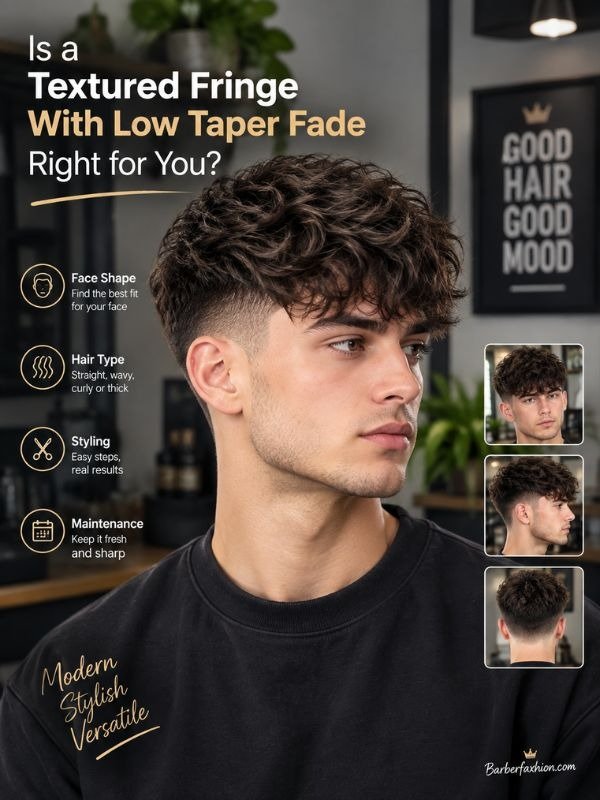
There’s no single face shape or hair type that automatically qualifies you for this haircut. The important thing is how the fringe and taper are adjusted.
Your natural hair direction, density, forehead height, and preferred styling routine all matter. A good barber should modify the cut rather than simply reproducing a reference photo.
Best Face Shapes
| Face Shape | Recommended Approach |
| Oval | Most fringe lengths can work |
| Round | Add texture and a little lift rather than keeping the fringe completely flat |
| Square | A softer, broken-up fringe can balance strong angles |
| Oblong | Keep excessive height under control |
| Heart | A balanced fringe can add visual fullness around the forehead |
| Diamond | Texture can soften the overall appearance |
For a round face, avoid creating a completely flat wall of hair across the forehead. Some separation and slight upward movement can make the haircut feel lighter.
For an oblong face, don’t overdo volume on top. Keeping the fringe slightly fuller and the sides balanced can create a more proportionate shape.
Best Hair Types
Straight Hair
Straight hair gives you a clean canvas for a textured fringe. The main challenge is that it can sometimes fall flat or look too uniform.
Your barber can create movement through point cutting and controlled layering. A small amount of matte styling product can then separate the strands.
Wavy Hair
Wavy hair is naturally suited to a textured look because the waves already create movement. The key is not to remove too much length or fight the natural pattern.
A medium-length fringe can allow the waves to form naturally instead of forcing them into a rigid shape.
Thick Hair
Thick hair can produce an excellent textured fringe, but excess weight needs to be managed carefully. If the top is too heavy, the fringe may fall forward as one large mass.
Ask your barber to remove bulk strategically while keeping enough density for the haircut to look full.
Fine Hair
Fine hair needs a slightly different approach. Excessive thinning can make it look even less dense, so texture should be created carefully.
Lightweight products and a little root lift can help the fringe look fuller without making it greasy or heavy.
Curly Hair
Curly hair can give this haircut a distinctive shape. However, your barber needs to work with the curl pattern instead of treating it like straight hair.
Leave enough length for the curls to form naturally and consider how much the hair shrinks once it dries.
How Long Should the Fringe Be?
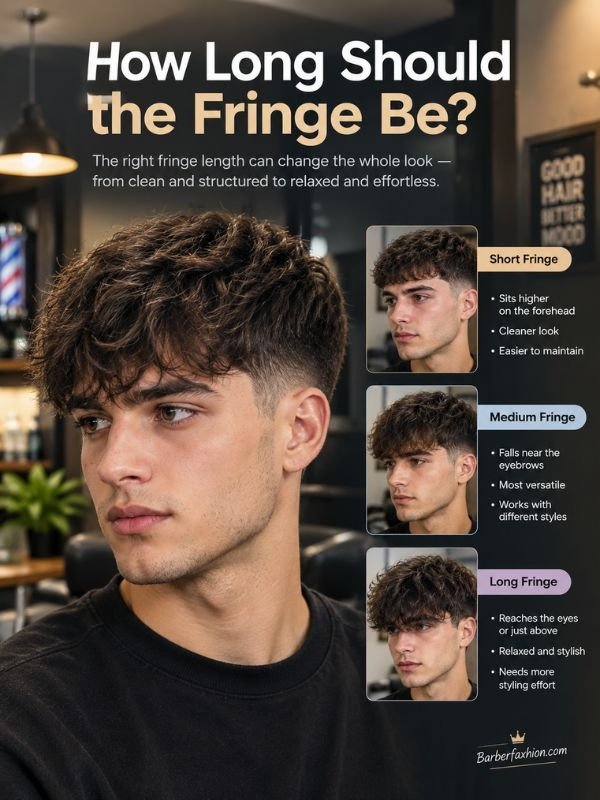
The right length depends on your face shape, hair texture, and how much styling you’re willing to do.
Short Textured Fringe
A short fringe sits higher on the forehead and gives the haircut a cleaner, more structured appearance.
It’s a good choice if you want less hair falling toward your eyes and prefer a simpler morning routine.
Medium Textured Fringe
Medium length is probably the most flexible option. It gives you enough hair to create separation, movement, and different styling directions.
You can wear it forward on relaxed days or push sections slightly to the side when you want a cleaner finish.
Long Textured Fringe
A longer fringe creates a softer and more relaxed appearance. It can also give you more styling options.
The trade-off is that longer hair usually requires more attention. If it naturally falls into your eyes or loses its shape during the day, you’ll need to style it more carefully.
Popular Textured Fringe With Low Taper Fade Variations
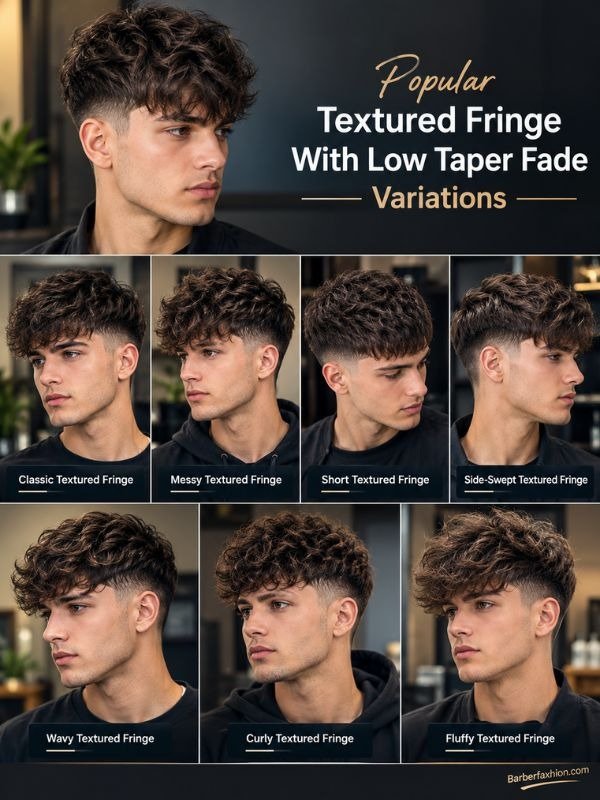
There isn’t just one way to wear this haircut. Small changes to the fringe and texture can completely change the finished look.
Classic Textured Fringe
The classic version keeps the fringe forward with moderate texture and a subtle taper around the edges.
It’s a safe option if you’re trying the haircut for the first time and don’t want an exaggerated style.
Messy Textured Fringe
A messy version uses more separation and an intentionally imperfect finish. The hair shouldn’t look randomly uncut; the messiness still needs shape.
Use your fingers instead of a comb when styling to keep the finish relaxed.
Short Textured Fringe
This version keeps the front relatively short and works well for men who prefer a sharper, easier-to-manage haircut.
The low taper provides the clean outline while the short fringe adds texture on top.
Side-Swept Textured Fringe
Instead of pushing every strand straight forward, the fringe is directed slightly toward one side.
This can be useful if a completely forward fringe doesn’t suit your natural hair direction or if you want a slightly more polished appearance.
Wavy Textured Fringe
Wavy hair adds natural movement, making this version particularly low-effort once the haircut is shaped correctly.
Don’t try to make every wave identical. The natural variation is part of the style.
Curly Textured Fringe With a Low Taper
Curly hair creates a more noticeable version of the look because the fringe has natural volume and separation.
Keep the taper clean but let the curls on top retain their character. Overworking the curls with too much product can make them look heavy.
Fluffy Textured Fringe
A fluffy version focuses on volume and softness rather than sharp definition.
It’s especially useful for people who like a fuller hairstyle and don’t want the top pressed flat against the forehead.
Low Taper vs. Mid Taper vs. High Taper
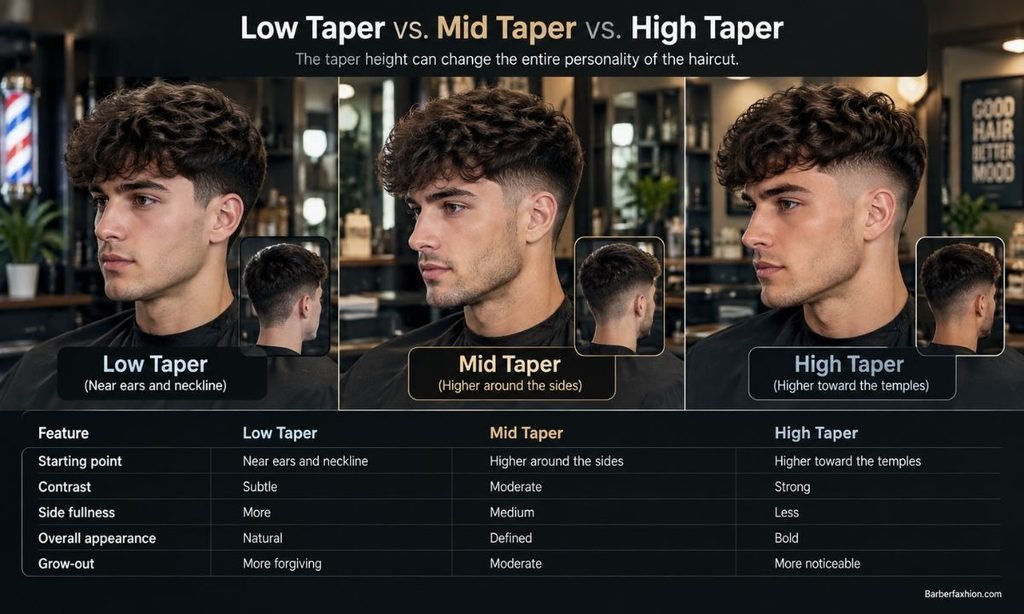
The taper height can change the entire personality of the haircut.
| Feature | Low Taper | Mid Taper | High Taper |
| Starting point | Near ears and neckline | Higher around the sides | Higher toward the temples |
| Contrast | Subtle | Moderate | Strong |
| Side fullness | More | Medium | Less |
| Overall appearance | Natural | Defined | Bold |
| Grow-out | More forgiving | Moderate | More noticeable |
Textured Fringe With Mid Taper Fade
A mid taper moves the transition higher than a low taper. It creates more visible contrast between the textured top and the sides.
Choose it if you like the basic fringe idea but want the sides to look more defined.
A textured fringe with mid taper fade can feel sharper and more modern, especially when the top has noticeable volume or separation.
Textured Fringe With Taper Fade
If you’re simply asking for a textured fringe with taper fade, make sure you clarify the taper height.
“Low,” “mid,” and “high” aren’t interchangeable. Showing your barber a reference photo and explaining where you want the transition to start can prevent an unwanted result.
Textured Fringe With Low Taper Fade for Asian Hair
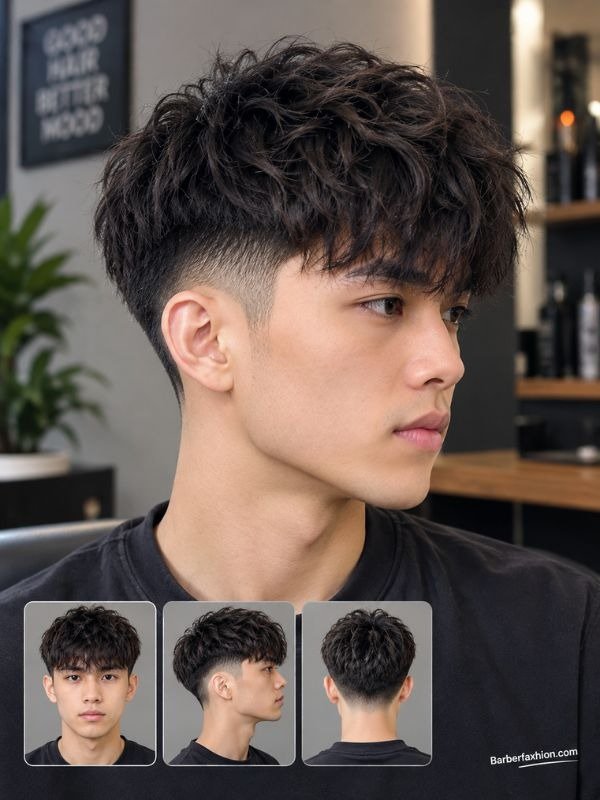
Asian hair is often naturally straight and can have a dense, resistant texture. That can be helpful for creating a structured fringe, but it can also cause the top to fall into one solid shape.
For a textured fringe with low taper fade Asian hair, ask for enough internal texture to create movement without excessively thinning the top.
A slightly longer fringe can also provide more styling flexibility. Matte products usually work better than heavy, shiny products if you want a modern textured finish.
How to Ask Your Barber for the Haircut
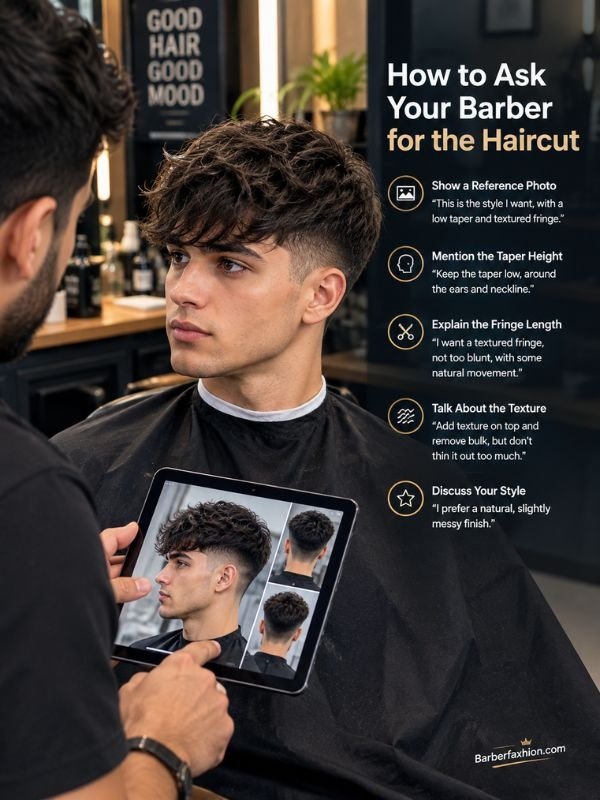
Knowing the haircut name is useful, but explaining the details is even better.
What to Tell Your Barber
Tell your barber:
- You want a low taper around the sideburns and neckline.
- You want the top left long enough to create a textured fringe.
- You want movement rather than a blunt front edge.
- You want the fringe to work with your natural hair direction.
- You don’t want the taper taken too high.
- Explain whether you prefer a messy, natural, or structured finish.
If you have thick hair, mention that you want the weight controlled without making the top look thin.
If your hair is curly or wavy, tell the barber how it behaves naturally after drying.
A Simple Barber Request
You can say:
“I’d like a low taper around the ears and neckline. Keep enough length on top for a textured fringe, and add natural separation without making the fringe too blunt. Keep the taper low and leave the top easy to style.”
Then show a reference photo. Your barber can adjust the details based on your actual hair.
Why a Reference Photo Helps
Two people can ask for the same haircut and get different results because their hair density, texture, growth patterns, and head shape aren’t identical.
Bring a photo showing the front and, ideally, the sides. If you have a particular taper height in mind, a side-view image is especially helpful.
Styling doesn’t have to take forever. The goal is to enhance the texture your barber created rather than completely reshape the haircut every morning
How to Style a Textured Fringe With Low Taper Fade
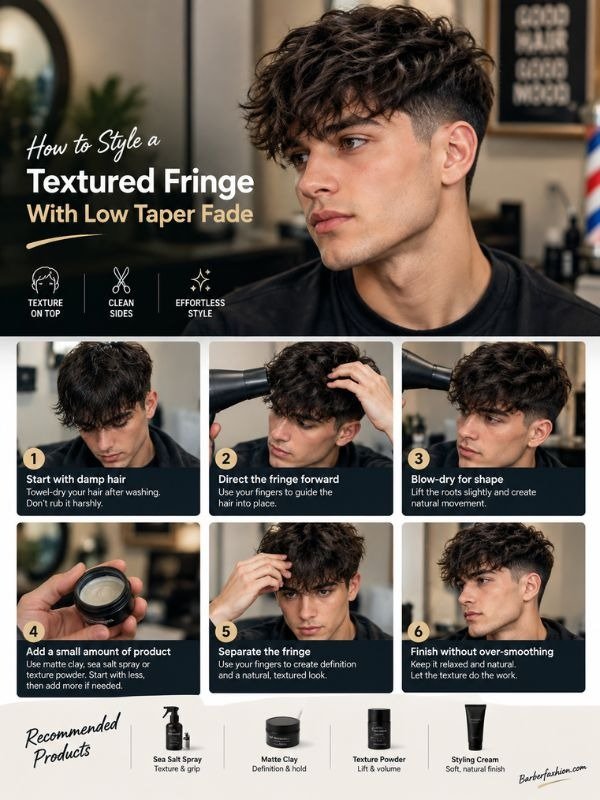
Step-by-Step Styling Routine
1. Start with slightly damp hair.
After washing, gently towel-dry your hair. Avoid aggressively rubbing the fringe.
2. Direct the fringe forward.
Use your fingers to guide the front into place.
3. Blow-dry for shape.
Use your fingers to create movement. If you want volume, lift the roots slightly while drying.
4. Apply a small amount of product.
Start with less than you think you need. You can always add more.
5. Separate the fringe with your fingers.
Pinch or twist a few sections lightly to create definition.
6. Leave the finish natural.
Don’t keep touching the hair once you’ve achieved the shape.
Styling It Messy
For a messy finish, use a matte clay or light styling product and work it through the hair with your fingers.
Push some sections forward and others slightly apart. Avoid making every strand point in exactly the same direction.
Styling It With More Volume
If your hair tends to sit flat, start with a lightweight pre-styling product such as sea salt spray.
Blow-dry upward from the roots, then use a small amount of matte product to define the fringe.
Best Products for a Textured Fringe
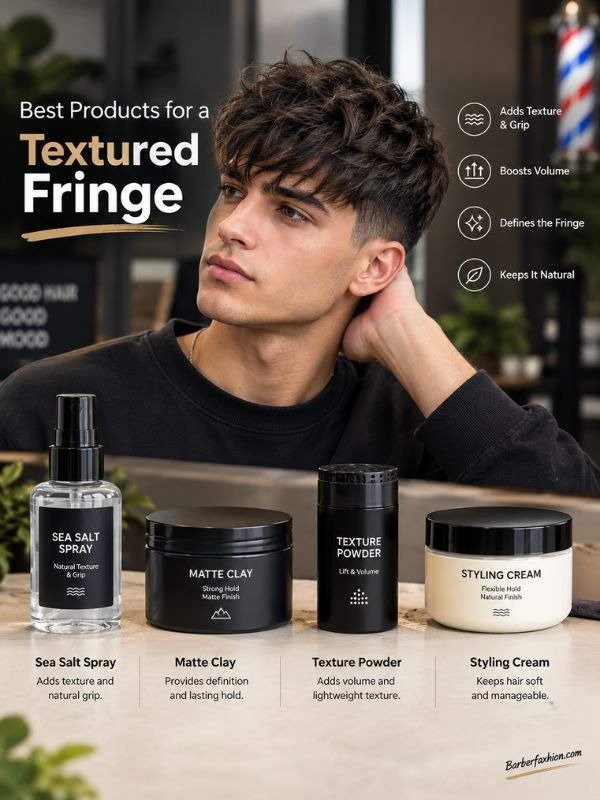
You don’t need a shelf full of products to maintain this haircut. One or two suitable products are usually enough.
| Product | Best For | Finish |
| Sea salt spray | Texture and grip | Natural |
| Matte clay | Definition and stronger hold | Matte |
| Texture powder | Lift and volume | Dry/matte |
| Styling cream | Softer, flexible styling | Natural |
For straight hair, sea salt spray can help create grip before styling. For thicker hair, matte clay can provide more control.
Fine hair may benefit from texture powder or a lightweight product that doesn’t weigh down the roots.
If your hair is naturally wavy or curly, a lighter cream can help maintain movement without making the hair stiff.
How to Maintain the Haircut
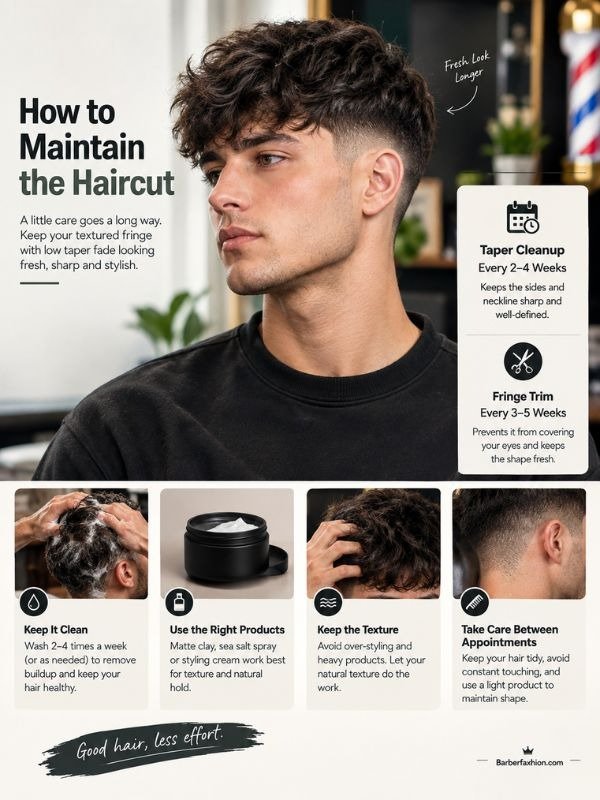
A low taper can be relatively forgiving as it grows, but the edges eventually lose their sharp appearance.
How Often Should You Clean Up the Taper?
For a consistently fresh appearance, many people choose a taper cleanup roughly every 2–4 weeks. Your actual schedule depends on how quickly your hair grows and how sharp you want the edges to remain.
You don’t necessarily need a complete haircut every time. A simple cleanup around the ears, sideburns, and neckline can sometimes be enough.
How Often Should You Trim the Fringe?
The fringe needs trimming when it becomes difficult to style or starts covering more of your face than you want.
If you’re growing it longer, tell your barber before cutting. Small changes can make a big difference to the final length.
Keeping the Texture Natural
Avoid drowning the fringe in the product. Too much clay, wax, or cream can make the textured pieces stick together.
Wash your hair according to how oily or dry your scalp and hair become, and don’t constantly flatten the fringe throughout the day.
Common Mistakes to Avoid
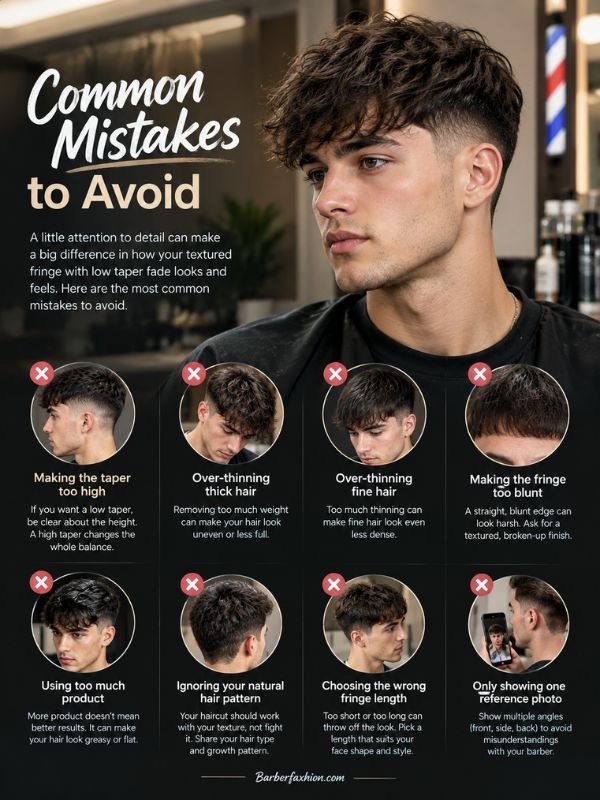
Making the Taper Too High
If you specifically want a low taper, make that clear before the clippers come out.
Taking the taper too high changes the entire balance of the haircut.
Over-Thinning Thick Hair
Removing too much weight can make thick hair look uneven or reduce the fullness you actually wanted.
Ask for controlled weight removal rather than simply saying, “Thin it out.”
Over-Thinning Fine Hair
Fine hair can lose visual density when aggressively texturized.
Your barber should create movement while preserving enough hair to keep the top looking full.
Making the Fringe Too Blunt
A perfectly straight front line can make a textured hairstyle look more like a traditional crop.
If you want movement, ask for a broken-up, natural edge.
Using Too Much Product
More product doesn’t automatically mean better texture. Heavy application can make the fringe greasy, stiff, or flat.
Start small and build gradually.
Ignoring Your Natural Hair Pattern
A reference picture may show someone with completely different hair.
If your hair naturally curls, waves, separates, or grows in a particular direction, the haircut should work with that pattern.
Textured Fringe vs. Other Popular Haircuts
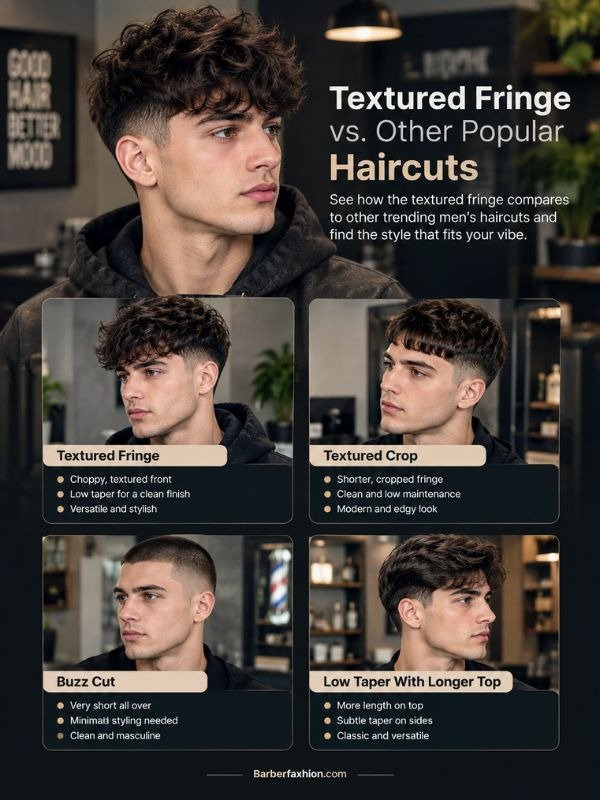
Textured Fringe vs. Textured Crop
These styles overlap, but they’re not always identical.
A textured crop usually has a more defined cropped shape and often keeps the fringe relatively short. A textured fringe can be longer and more flexible, giving you more options for movement and styling.
If you want something relaxed and adaptable, the longer fringe may be the better direction.
Textured Fringe vs. Buzz Cut
A buzz cut removes most of the styling options because the hair is kept very short and uniform.
A textured fringe gives you much more freedom with shape, direction, volume, and texture. The trade-off is that it requires more styling and maintenance.
Textured Fringe vs. Skin Fade
A skin fade creates a much stronger contrast by taking the sides extremely short near the skin.
A low taper is subtler. If you want the haircut to retain more natural fullness around the sides, the low taper is usually the calmer option.
FAQs About Textured Fringe With Low Taper Fade
Is a textured fringe with a low taper good for a round face?
Yes, but the fringe should be shaped carefully. Adding texture and slight movement instead of keeping the front completely flat can create a more balanced appearance.
What hair type is best for a textured fringe?
Straight, wavy, thick, fine, and curly hair can all work. The key is adapting the amount of texture, length, and weight removal to the hair’s natural behavior.
How long should the fringe be?
There isn’t one perfect length. Short fringes are easier to manage, medium fringes offer the most flexibility, and longer fringes provide a softer, more relaxed appearance.
How often should you get a low taper cleaned up?
Around 2–4 weeks is a common maintenance range if you want the edges looking consistently sharp. You can stretch appointments longer if you prefer a more grown-out appearance.
Is a textured fringe easy to style?
Yes. Once the haircut is shaped properly, most versions can be styled with your fingers, a blow dryer, and a small amount of suitable product.
Conclusion
A textured fringe with low taper fade is a strong choice if you want a modern men’s haircut that doesn’t rely on an extreme fade or complicated styling. The textured top creates movement and personality, while the low taper keeps the ears, sideburns, and neckline clean without removing too much side fullness.
The best version isn’t necessarily the one that looks best on someone else. Choose the fringe length based on your face shape, work with your natural hair texture, and tell your barber exactly how low you want the taper. Bring a reference photo, keep the styling simple, and you’ll have a haircut that’s much easier to make your own.