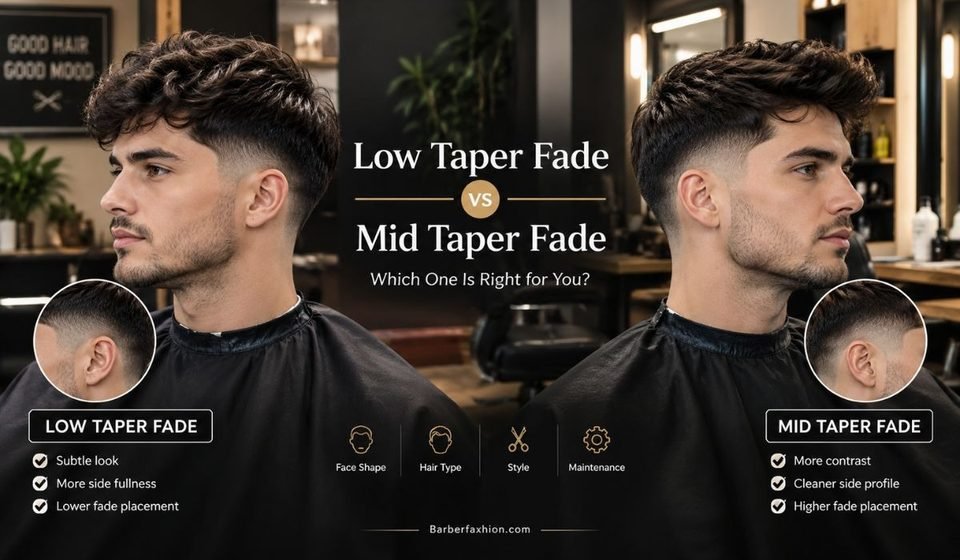

Choosing a new haircut sounds simple until you’re sitting in the barber’s chair and hear the question: “Low taper or mid taper?” Both can look clean, modern, and stylish, but the difference in fade placement changes the overall shape of your haircut. Choosing the wrong one can leave you with more contrast, less side length, or a style that doesn’t quite match what you had in mind.
The good news is that there’s no single winner. The right taper depends on your face shape, hair type, preferred level of contrast, styling routine, and even how conservative you want your haircut to look. This guide breaks down low taper fade vs mid taper fade so you can understand the difference, compare the two styles, and tell your barber exactly what you want.
Quick answer: A low taper keeps the taper closer to the ears and neckline, giving you a subtle and natural finish. A mid taper rises higher on the sides, creating more contrast and a sharper silhouette. Choose a low taper for a softer, more conservative look, or a mid taper when you want a more noticeable and defined finish.
The Short Version
If you don’t want to read the entire guide, here’s the basic idea.
A low taper fade keeps the transition low around the sideburns, ears, and neckline. More of your natural side length remains, so the haircut usually looks understated and blends easily with longer hairstyles. It’s a strong option if you want something neat without making the fade the main feature of your haircut.
A mid taper fade moves the transition higher up the sides. This creates more visible contrast between the shorter sides and the hair above them. The result can feel sharper and more structured, especially when paired with styles such as a textured crop, quiff, or slick back.
Choose a Low Taper If…
- You prefer a subtle haircut.
- You want to keep more length around the sides.
- You like a natural transition rather than strong contrast.
- You wear your hair longer on top and want the taper to support it.
- You prefer a haircut that can grow out without changing dramatically.
- You need a conservative appearance for school, work, or formal settings.
Choose a Mid Taper If…
- You want the taper to be more noticeable.
- You prefer cleaner, tighter sides.
- You like stronger contrast around the temples.
- You want a sharper overall silhouette.
- Your hairstyle benefits from more definition around the sides.
- You don’t mind giving the haircut more attention as it grows out.
The easiest way to think about it is this: low taper = subtle transition, mid taper = stronger transition.
Understanding Low, Mid, and High Taper Fades
Before comparing the two, it helps to understand what “low,” “mid,” and “high” actually describe. These terms mainly refer to where the taper begins and how high the shorter area travels on the sides of your head.
What Is a Low Taper Fade?
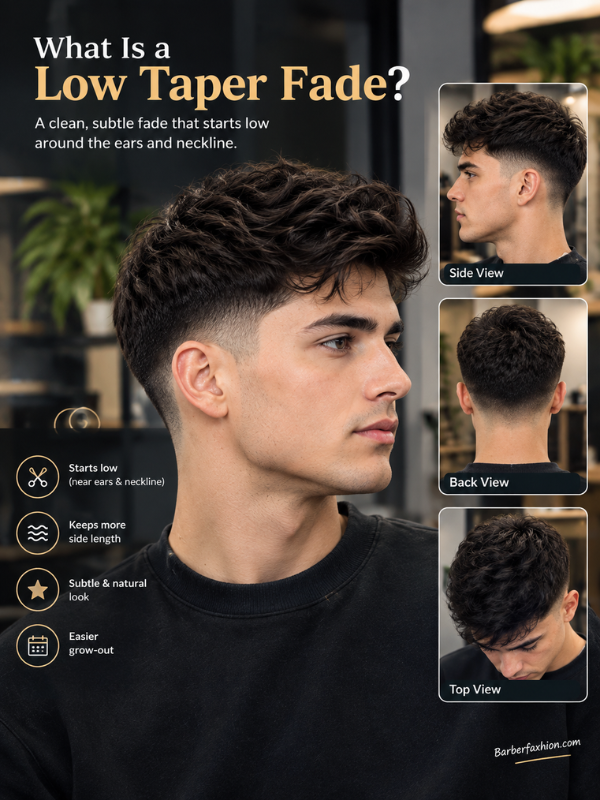
A low taper keeps the shortest section relatively close to the ears and neckline. Instead of taking the fade high up the sides, the barber gradually reduces the hair near the lower edges of the haircut.
This makes the transition less dominant. From the front, the top remains the main focus. From the side, you can still see plenty of hair around the upper sides.
That makes a low taper particularly flexible. It can work with a side part, textured top, fringe, slick back, quiff, or longer layered style.
The key feature isn’t simply that the hair is short. It’s where the shortness is concentrated.
A well-executed low taper should transition smoothly from the shortest area into the surrounding length. The exact blend can vary depending on your hair texture, density, and the look you’re trying to achieve.
What Is a Mid Taper Fade?
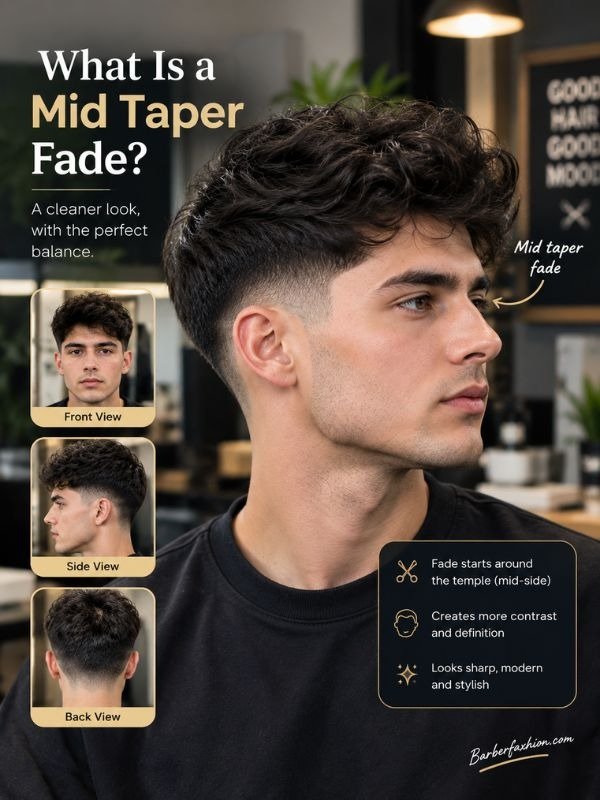
A mid taper places the transition higher than a low taper. Because more of the sides are reduced, the haircut generally creates stronger separation between the top and sides.
That extra contrast can make the hairstyle appear sharper. It can also make the shape of the haircut more obvious from different angles.
A mid taper works especially well when you want the sides to support a structured top. Think textured crops, quiffs, comb overs, short curls, and other styles where definition matters.
However, a mid taper doesn’t automatically mean an extreme haircut. Your barber can control how tight the sides become and how smoothly the transition blends into the remaining hair.
What Is a High Taper Fade?
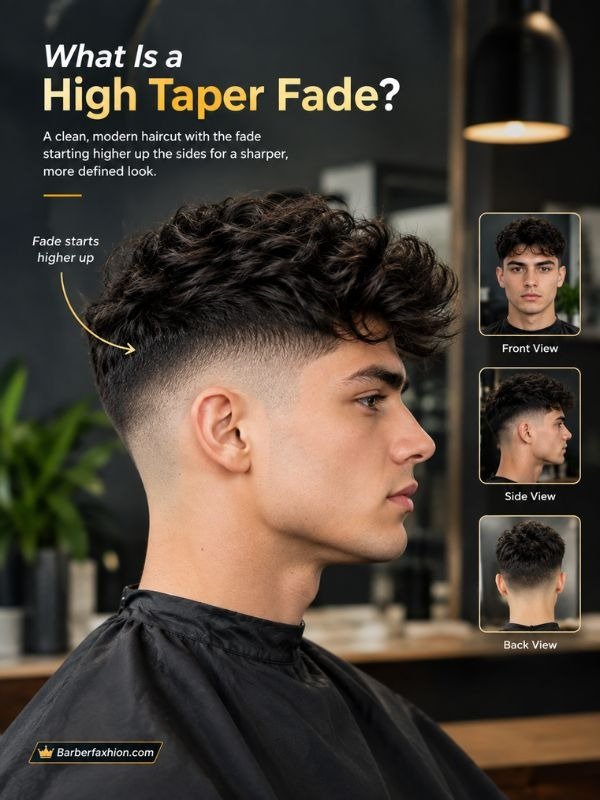
A high taper takes the transition higher again. More of the sides are brought into the shorter area, making the difference between the top and sides more noticeable.
Compared with a low taper, a high taper usually creates a more dramatic silhouette. It can suit people who want the sides to feel significantly cleaner and tighter.
The important point is that low, mid, and high describe placement, not whether one haircut is automatically better.
Mid Low Taper Fade: What Does It Mean?
You may also hear phrases such as “mid-low taper” or “low-mid taper.” These aren’t always used consistently between barbers.
Usually, the phrase describes a taper that sits somewhere between a traditional low and mid placement. If you’re asking for this look, don’t rely on the name alone.
Instead, show your barber a reference photo and explain how high you want the transition to travel. A photo can communicate the intended placement much more clearly than a vague label.
Low Taper Fade vs Mid Taper Fade: How They Look Side by Side
The biggest difference between a low and mid taper is placement.
With a low taper, the shorter transition stays closer to the bottom edges of the haircut. The upper sides retain more weight and fullness.
With a mid taper, that transition moves upward. The upper sides become more defined, so the haircut can have a cleaner and more noticeable shape.
Difference in Fade Placement
Imagine drawing a horizontal line around the sides of your head.
A low taper keeps most of the noticeable taper below that imaginary line. A mid taper moves the transition higher.
This sounds like a small difference, but even a few centimeters can change the appearance of the entire haircut.
That’s why saying “just give me a taper” isn’t always enough. You should communicate where you want the taper to sit.
Difference in Contrast and Shape
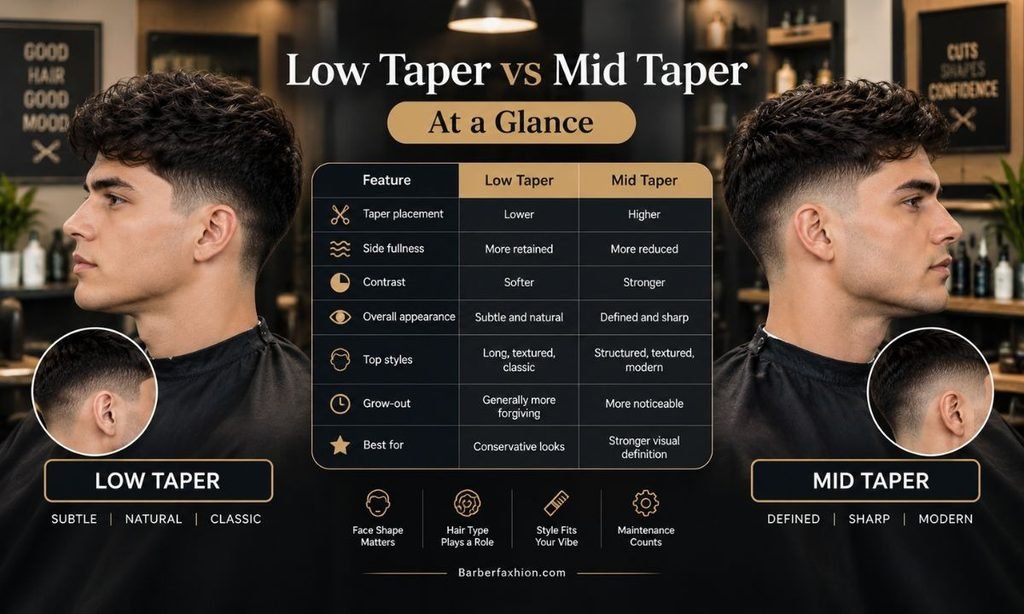
Low tapers generally create less contrast between the top and sides.
Mid tapers create more contrast because more side hair is reduced.
Neither approach is automatically better. It depends on what you want your haircut to communicate.
A low taper can feel relaxed, natural, and understated. A mid taper can feel sharper, cleaner, and more defined.
Low Taper vs Mid Taper at a Glance
| Feature | Low Taper | Mid Taper |
| Taper placement | Lower | Higher |
| Side fullness | More retained | More reduced |
| Contrast | Softer | Stronger |
| Overall appearance | Subtle and natural | Defined and sharp |
| Top styles | Long, textured, classic | Structured, textured, modern |
| Grow-out | Generally more forgiving | More noticeable |
| Best for | Conservative looks | Stronger visual definition |
If you’re still undecided, look at your current hairstyle. If you like the amount of side fullness you already have, a low taper may be easier to adapt to. If your sides feel bulky and you want a cleaner shape, a mid taper may be worth considering.
Which Taper Looks More Professional?
There’s a common misconception that one taper is automatically professional while the other isn’t. In reality, both can look polished when they’re blended properly and maintained well.
Low Taper for Conservative Settings
A low taper is often the safer choice when you want your haircut to remain understated.
Because less of the sides are reduced, the haircut doesn’t immediately draw attention to the fade. This can make it easier to pair with formal clothing, traditional hairstyles, or workplaces with conservative grooming expectations.
A low taper can also work well if you don’t want to visit the barber frequently just to maintain a very sharp outline.
Can a Mid Taper Still Look Professional?
Absolutely.
A mid taper can look clean and professional when the transition is controlled and the top is styled appropriately. The difference is that the taper itself is more visible.
For example, a neatly styled mid taper with a side part can look very polished. The same taper with a heavily messy or highly textured top may give a more casual impression.
Your styling choices matter just as much as the taper height.
Which Should You Choose?
If your priority is subtle and conservative, lean toward a low taper.
If you want definition without going as high as a high taper, a mid taper can give you that middle ground.
When in doubt, start lower. You can always ask for a higher taper at your next appointment, but changing the placement immediately requires cutting away more hair.
Which Taper Suits Your Face Shape?
Your face shape shouldn’t completely determine your haircut, but it can help you decide how much height, width, and contrast you want around your head.
The goal is to create a balanced overall shape rather than blindly following a rule.
Oval Face
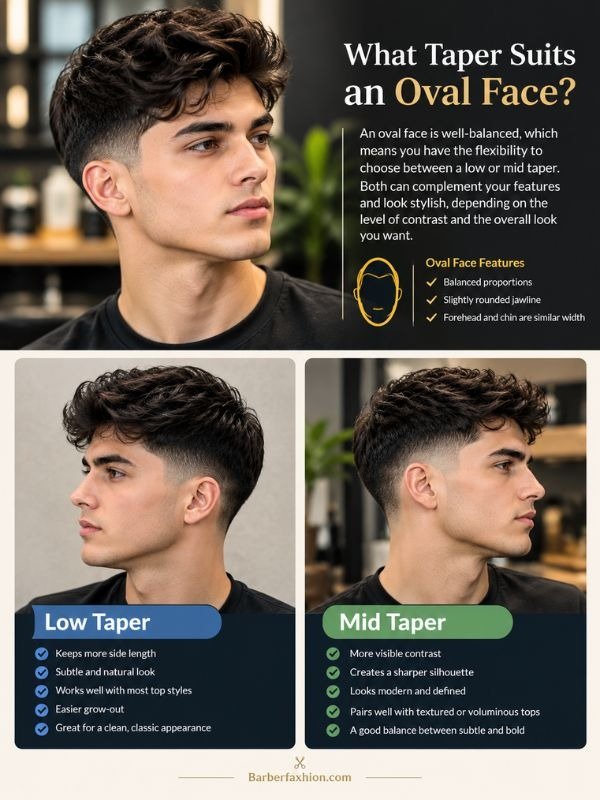
An oval face generally gives you plenty of flexibility.
You can experiment with either a low or mid taper depending on your preferred style. A low taper works well when you want to preserve a softer outline, while a mid taper can add more definition.
Your top hairstyle can then determine whether you want additional volume, texture, or length.
Round Face
If your face looks fuller around the cheeks, you may prefer a haircut that creates more visual structure.
A mid taper can help make the sides feel cleaner while leaving room to build height on top. A textured quiff or slightly lifted hairstyle can reinforce that vertical shape.
A low taper can also work. Just avoid automatically removing too much hair from the sides without considering how the top balances the haircut.
Square Face
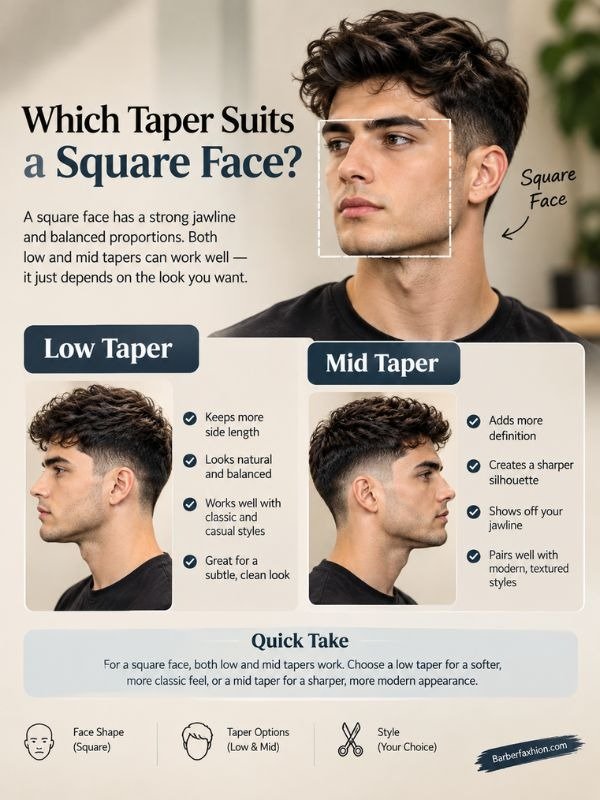
Square faces already have strong angles around the jaw and forehead.
Both taper heights can work. A low taper can preserve a classic, balanced appearance, while a mid taper can emphasize the clean geometry of the haircut.
Your choice should come down to whether you want a softer or more defined finish.
Oblong or Long Face
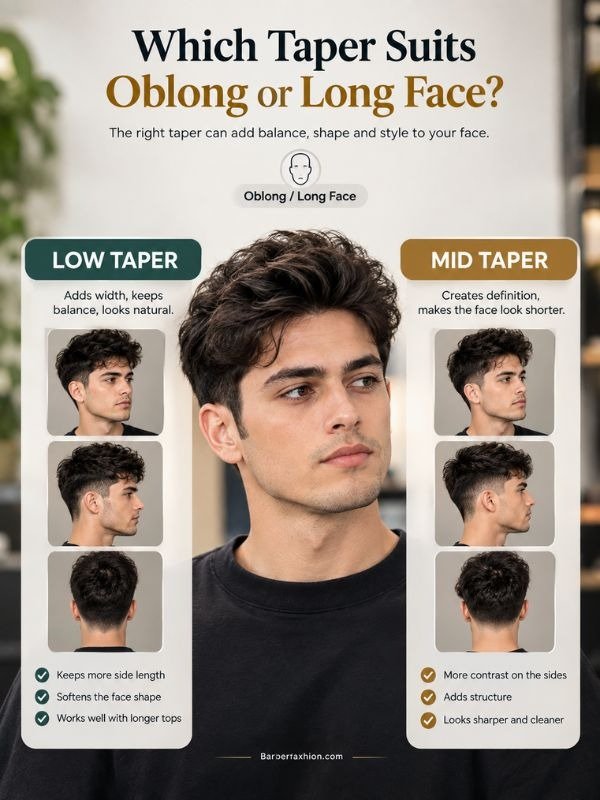
With a longer face, adding excessive height on top may make the face appear even longer.
A low taper can help preserve some fullness around the sides. You can also choose a hairstyle with texture or fringe instead of pushing all the volume upward.
A mid taper can still work, but the top and side proportions should be considered together.
Heart-Shaped Face
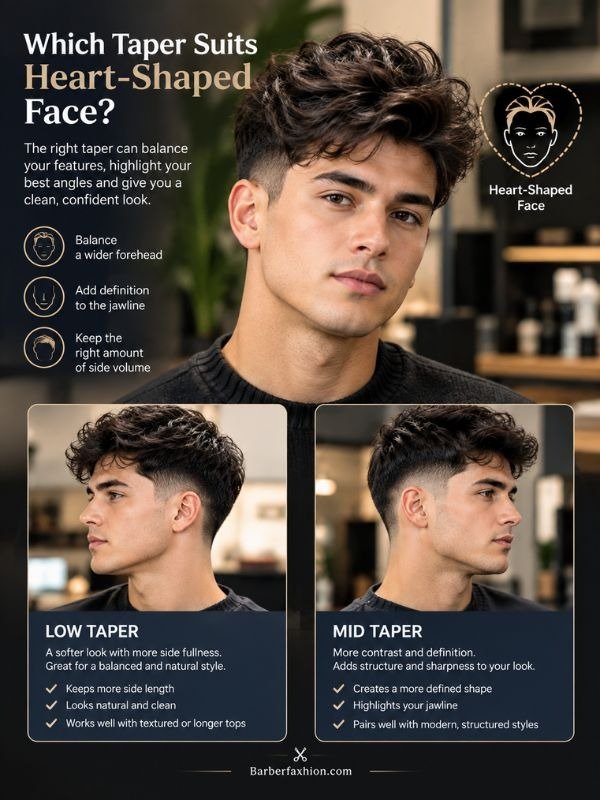
A heart-shaped face tends to be wider around the upper face and narrower toward the chin.
A balanced hairstyle can help distribute visual weight. A low taper paired with a textured or layered top can create a softer transition.
A mid taper is also possible if you prefer more definition. Just make sure the top isn’t creating an overly heavy shape around the forehead.
Diamond Face
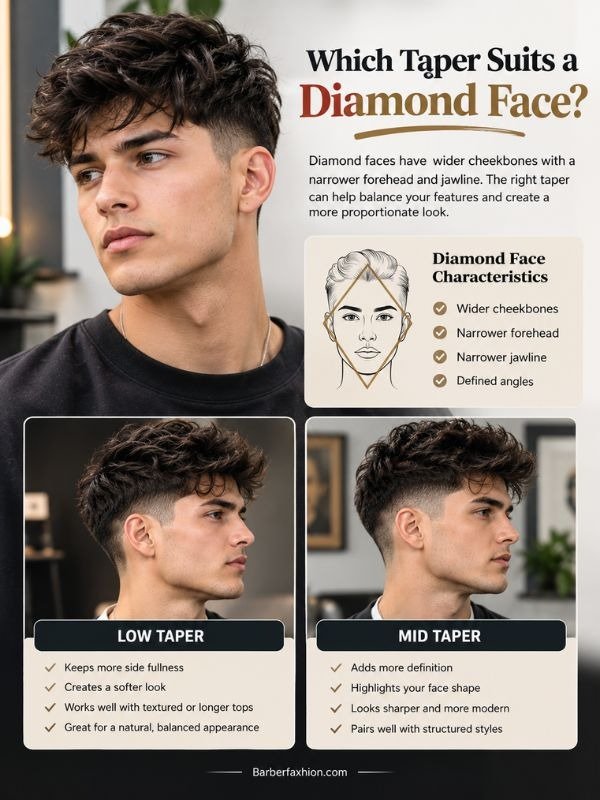
Diamond-shaped faces often have noticeable cheekbone width with narrower forehead and jaw areas.
A textured top can work well because it adds movement rather than making the haircut look overly rigid. Both low and mid tapers can complement this approach.
The final choice should depend on your hair density and the amount of contrast you want.
Remember: face shape is a guide, not a rulebook. Your hair’s natural growth pattern, thickness, and styling habits can matter just as much.
Low Taper Fade vs Mid Taper Fade for Different Hair Types
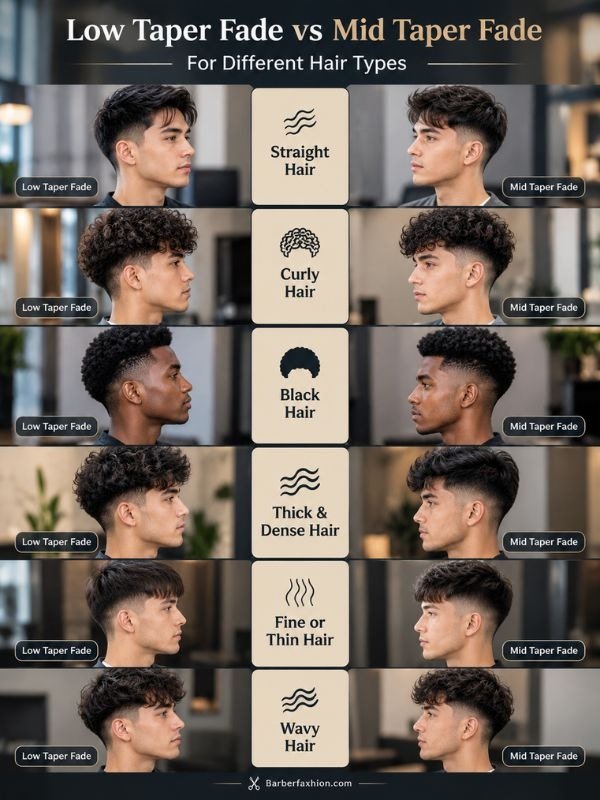
Hair type can dramatically change how a taper looks. Two people can receive the same taper placement and end up with very different results because their hair behaves differently.
Straight Hair
Straight hair makes the transition between different lengths easy to see.
A low taper works well if you want the haircut to retain fullness and maintain a classic shape. It’s particularly useful with side parts, middle parts, longer layers, and slicked-back styles.
A mid taper creates more separation between straight hair on top and the shorter sides. This can make a textured crop, quiff, or comb-over appear more defined.
If your straight hair is very dense, tell your barber whether you want the upper sides debulked. A taper and a heavy reduction of bulk aren’t exactly the same thing.
Curly Hair
Curly hair can make taper placement look different because curls add volume and movement.
A low taper allows more of that natural fullness to remain around the sides. It can create a softer transition into curly or textured hair on top.
A mid taper removes more side weight and can make the curls on top stand out more strongly.
For curls, communication is especially important. Your barber should understand how your hair behaves when dry, because curls can shrink and change shape after washing.
Black Hair
For Black hair, the best taper height depends on the specific texture, density, curl pattern, and desired silhouette.
A low taper can keep the haircut subtle while maintaining more fullness. It can pair well with curls, waves, twists, coils, and textured tops.
A mid taper can create stronger contrast and give a sharper outline around the sides.
Rather than assuming that one taper works for every Black hairstyle, focus on the shape you want. Explain whether you want to preserve fullness, create stronger separation, or make the top stand out.
Thick and Dense Hair
Thick hair often benefits from careful control of bulk.
A low taper can leave more weight around the sides, which is useful if you like a fuller appearance. However, if your hair tends to puff outward, you may need some controlled debulking above the taper.
A mid taper can create a cleaner outline by taking more weight away from the sides.
The important distinction is between taper height and bulk removal. Moving from low to mid isn’t always the only solution for thick hair.
Fine or Thin Hair
With fine hair, preserving visual density can be important.
A low taper may help because more side length remains. The top can then be styled with texture or volume to make the hair appear fuller.
A mid taper can still work, especially if you prefer a clean and minimal style. However, taking too much from the sides can make the remaining top look more isolated.
Ask your barber to consider your natural density before choosing how high the taper should go.
Wavy Hair
Wavy hair sits between straight and curly textures.
A low taper can create a relaxed look while allowing the natural wave to continue toward the sides. It’s a strong pairing for messy layers, textured fringes, and medium-length tops.
A mid taper makes the wave pattern on top more prominent by creating greater contrast below it.
If your waves are thick, ask your barber how much weight should remain around the sides. Removing too much can change the balance of the style.
Low vs Mid vs High Taper Fade: What’s the Difference?
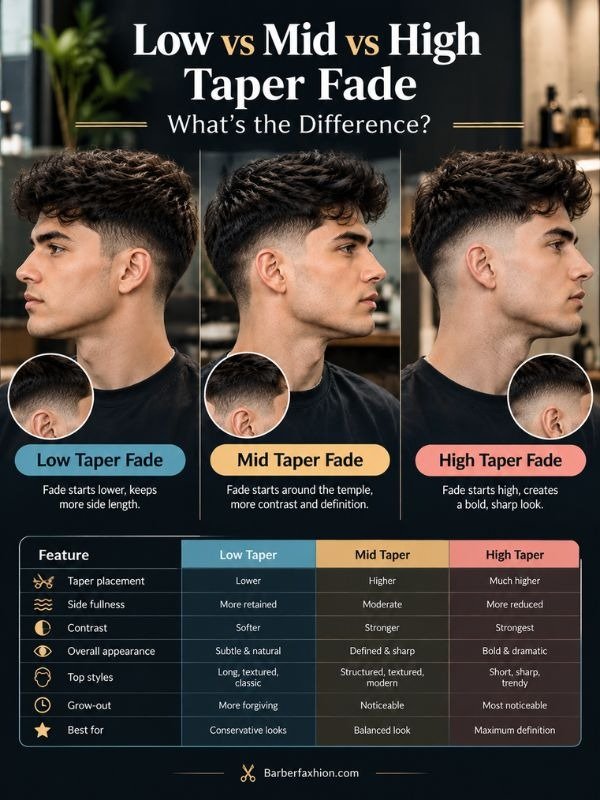
Adding the high taper to the comparison makes the choice easier because you can see where each option sits on the spectrum.
Think of the three styles as a progression:
Low → Mid → High
As the taper moves higher, more of the sides become part of the shorter transition.
Low Taper Fade vs Mid Taper Fade
The low taper is more subtle and retains more side fullness.
The mid taper is more visible and creates stronger contrast.
If you’re trying a taper for the first time, a low taper can be an easier starting point. If you already like short, defined sides, a mid taper may feel more natural.
Mid Taper Fade vs High Taper Fade
A mid taper sits between the subtle low placement and the more dramatic high placement.
A high taper removes more side hair higher up the head. This can make the top look more isolated and create a stronger silhouette.
If you want definition but don’t want the sides to feel extremely tight, a mid taper can offer a useful compromise.
Low Taper Fade vs High Taper Fade
These are the two ends of the spectrum.
A low taper preserves more side weight and produces a softer transition. A high taper creates a much stronger change between the top and sides.
Your choice should reflect your desired contrast. If you want people to notice the haircut’s structure immediately, a higher taper may make sense. If you want the hairstyle itself to remain the focus, a low taper is usually more understated.
Which Taper Height Should You Choose?
Use this simple guide:
| Your preference | Recommended taper |
| Very subtle | Low |
| Natural side fullness | Low |
| Moderate contrast | Mid |
| Sharper sides | Mid |
| Strong contrast | High |
| Dramatic silhouette | High |
There is also room between these categories. Your barber can adjust the transition rather than treating low, mid, and high as rigid measurements.
Pairing Each Taper With Popular Top Styles
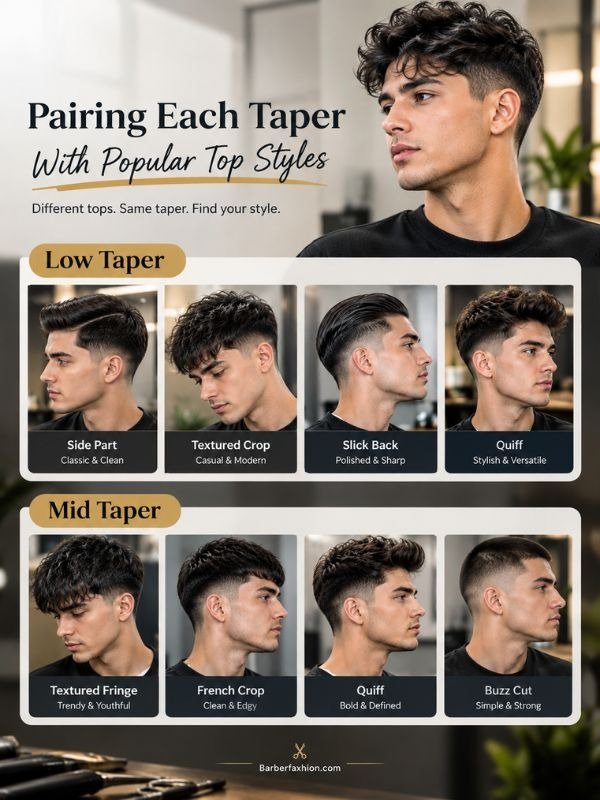
The taper doesn’t exist by itself. Your top hairstyle changes how the final haircut looks.
Low Taper + Side Part
A side part with a low taper creates a classic and controlled appearance.
The taper cleans the area around the ears and neckline while the longer top maintains the traditional shape. This combination works particularly well if you don’t want the haircut to look overly aggressive.
Low Taper + Textured Crop
A textured crop gives the top movement while the low taper keeps the sides relatively natural.
This is useful if you want modern texture without making the sides extremely tight.
Low Taper + Slick Back
A slick back can look polished with a low taper because the taper doesn’t compete with the longer top.
Keep enough length on top to create the desired direction. The result can range from relaxed to formal depending on how much product you use.
Low Taper + Quiff
A quiff already creates height and movement at the front.
Pairing it with a low taper can balance that volume without creating excessive contrast around the sides.
Mid Taper + Textured Fringe
A mid taper can make a textured fringe stand out.
The tighter sides create a stronger frame around the face, while the fringe provides movement across the forehead.
Mid Taper + French Crop
The French crop is naturally structured, so a mid taper can reinforce its clean outline.
This combination works especially well when you want the haircut to have a clear shape rather than a loose, flowing appearance.
Mid Taper + Quiff
A mid taper gives the quiff a stronger foundation.
Because the sides are cleaner, the volume on top becomes more noticeable. This can create a sharp modern appearance without requiring an extremely high taper.
Mid Taper + Buzz Cut
A buzz cut already keeps the hair short, so the taper becomes a major part of the overall shape.
A mid taper can add definition around the sides while creating a gradual transition into the short top.
Maintenance & Upkeep
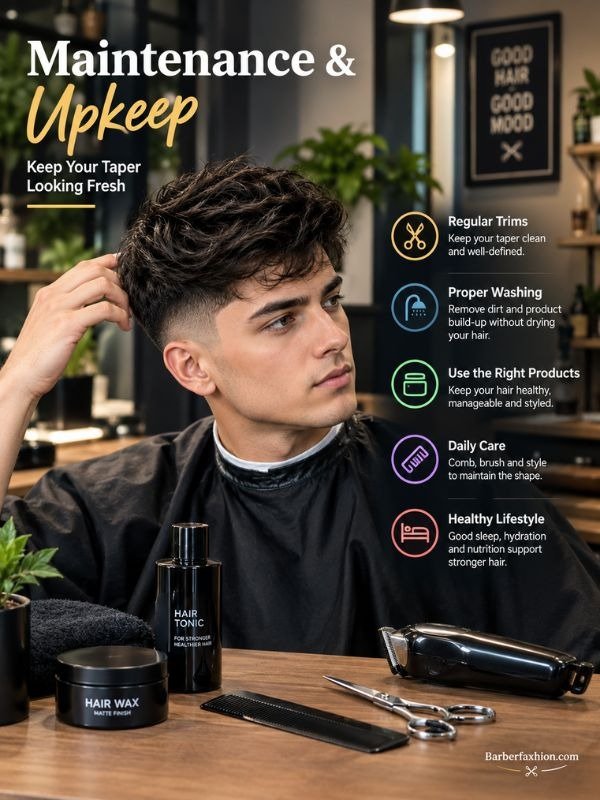
Every haircut changes as it grows. The question isn’t whether your taper will grow out, but how noticeable you want that change to be.
How Often Should You Refresh a Low Taper?
There isn’t one perfect schedule.
Some people prefer to refresh the taper as soon as the outline loses its sharpness. Others let it grow for longer and return when the overall shape changes.
A low taper generally gives you a little more flexibility because the transition begins lower on the head.
How Often Should You Refresh a Mid Taper?
A mid taper can show regrowth more clearly because the shorter area extends higher.
If you like a crisp, defined finish, you may want regular barber visits. If you’re comfortable with a softer appearance, you can let it grow longer.
Your hair growth rate, texture, and desired sharpness all affect the timing.
Which One Has Easier Grow-Out?
For many people, the low taper has a more forgiving grow-out.
Because more of the natural side length remains, the transition can become less obvious as the hair grows.
A mid taper may change its appearance more noticeably because the contrast between the shorter and longer sections becomes less defined.
How to Keep Either Taper Looking Clean
Between barber appointments:
- Keep the neckline clean if needed.
- Wash according to your hair and scalp needs.
- Avoid using excessive styling product.
- Brush or style the top into its intended direction.
- Don’t attempt major fade corrections yourself.
- Tell your barber what you liked or disliked at the previous appointment.
Maintenance isn’t just about cutting the sides. The health and condition of the top also affect the final appearance.
Everyday Styling & Products
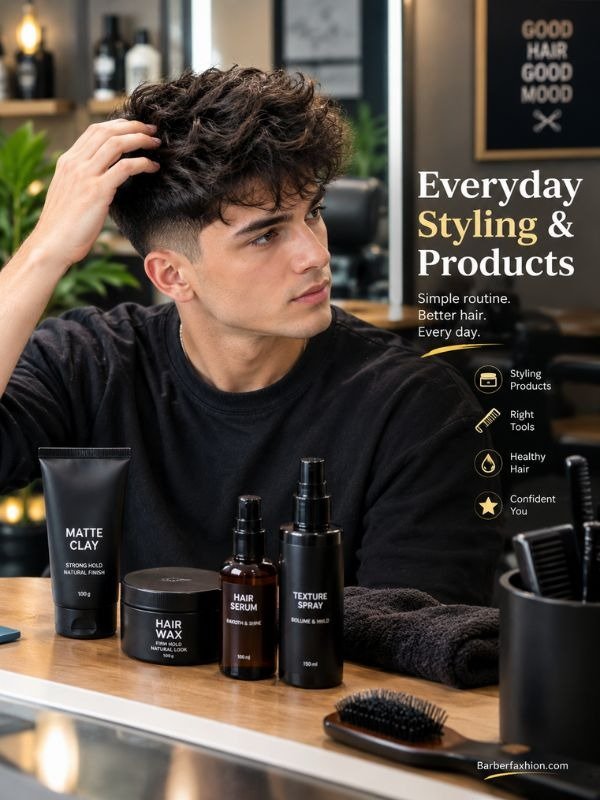
The best styling routine depends on your hair type and the look you’re trying to create.
Styling a Low Taper
A low taper pairs naturally with relaxed styles.
For a textured look, use a small amount of lightweight styling product and work it through the top. For a side part or slick back, use a product that provides enough control to hold the direction without making the hair look stiff.
The taper itself doesn’t require complicated styling. Most of the work happens on top.
Styling a Mid Taper
A mid taper often benefits from styles that take advantage of the stronger contrast.
You can use a matte clay for texture, a styling cream for softer control, or a pomade when you want more shine and structure.
Start with a small amount. Adding more product is easy, while removing excess product can be annoying.
Choosing Products by Hair Type
Fine hair: Lightweight creams or texture products can prevent the hair from feeling weighed down.
Thick hair: A stronger clay or styling product may help control bulk and maintain direction.
Wavy hair: Creams can enhance natural movement without making the hair excessively rigid.
Curly hair: Products designed for moisture and curl definition can help maintain the natural pattern.
Your product should support your hair rather than fight against it.
Pros and Cons at a Glance
Low Taper Fade: Pros and Cons
| Pros | Cons |
| Subtle appearance | Less dramatic contrast |
| Keeps more side fullness | May not remove enough bulk for some thick hair |
| Works with many top styles | Can look less sharp if you prefer a strong fade |
| Generally forgiving grow-out | Less visual emphasis on the sides |
| Suitable for conservative settings | May feel too understated for some people |
The biggest advantage of a low taper is flexibility. It doesn’t force your haircut into an extremely tight shape.
Mid Taper Fade: Pros and Cons
| Pros | Cons |
| Stronger definition | Grow-out can be more noticeable |
| Cleaner side profile | Removes more side length |
| Works well with structured styles | Requires careful blending |
| Creates stronger contrast | May feel too bold for conservative preferences |
| Can emphasize the top | Less natural side fullness |
A mid taper is a good choice when you want your haircut to have more visible structure.
How to Ask Your Barber
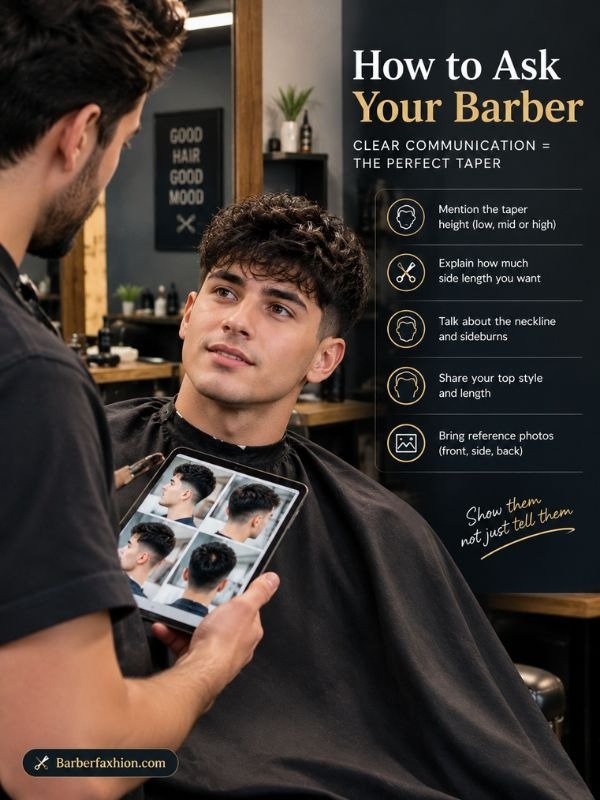
Knowing what you want is only half the job. You also need to communicate it clearly.
What to Say for a Low Taper
Instead of saying only, “Give me a low taper,” explain the result you want.
You could say:
“I’d like a low taper around the sideburns and neckline. Keep the upper sides fuller and don’t take the taper too high. I want the transition to look subtle.”
Then explain what you’re doing with the top.
For example:
“Keep the top long enough for a textured style, and don’t remove too much weight from the sides.”
This gives your barber information about both the taper and the overall shape.
What to Say for a Mid Taper
For a mid taper, be clear that you want the transition higher.
You could say:
“I’d like a mid taper with the transition sitting higher on the sides. Keep the blend smooth and leave enough length on top for my hairstyle.”
If you’re concerned about going too high, say so.
You can also ask your barber to show you where the taper will sit before they start cutting.
Bring a Reference Photo
A reference photo can eliminate a lot of confusion.
Try to find an image that shows the haircut from more than one angle. A front-facing image tells only part of the story.
Ideally, your reference should show:
- Front
- Side
- Back
- Top length
- Taper placement
Don’t assume the barber will copy every detail exactly. Your hair texture and head shape may require adjustments.
The goal is to communicate the shape and effect you want.
Common Mistakes to Avoid
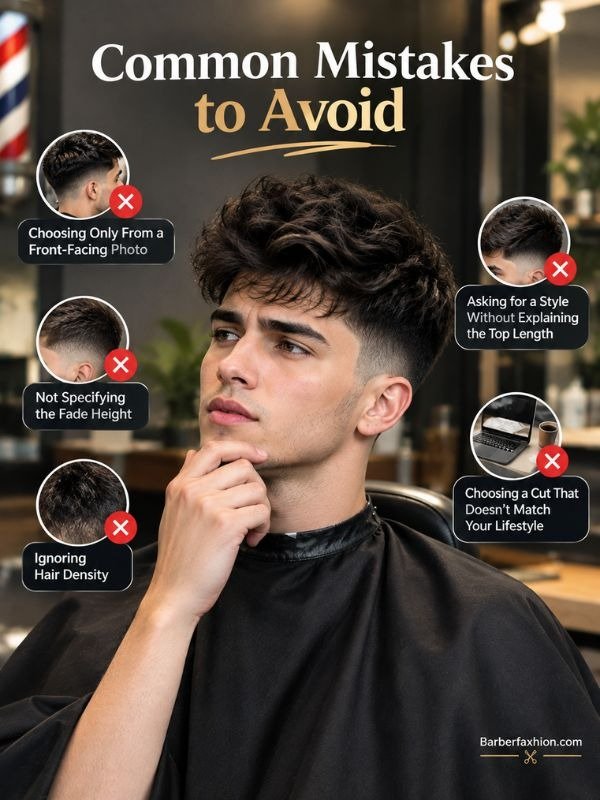
Choosing between a low and mid taper becomes much easier when you know what can go wrong.
Choosing Only From a Front-Facing Photo
The front view doesn’t tell you how high the taper sits.
Always inspect the side and back of a reference haircut before deciding.
Not Specifying the Fade Height
“Make it clean” can mean different things to different people.
If you want a low taper, say low. If you want a mid taper, say mid. If you’re unsure, show your barber a photo.
Ignoring Hair Density
Two people with the same haircut can have completely different results.
Thick hair may need weight control. Fine hair may need more preservation. Curly hair may shrink after cutting.
Tell your barber how your hair normally behaves.
Asking for a Style Without Explaining the Top Length
A taper can’t compensate for a top that isn’t long enough for your desired style.
If you want a quiff, slick back, fringe, or textured crop, explain that before the cut begins.
Choosing a Cut That Doesn’t Match Your Lifestyle
A haircut can look great in a photo but still be inconvenient for your routine.
Ask yourself:
- How often do I want to visit the barber?
- Do I style my hair every morning?
- Does my school or workplace have grooming expectations?
- Do I prefer natural or sharp-looking hair?
- How much time do I want to spend maintaining it?
The best haircut is one you can realistically live with.
Final Verdict: Low Taper or Mid Taper?
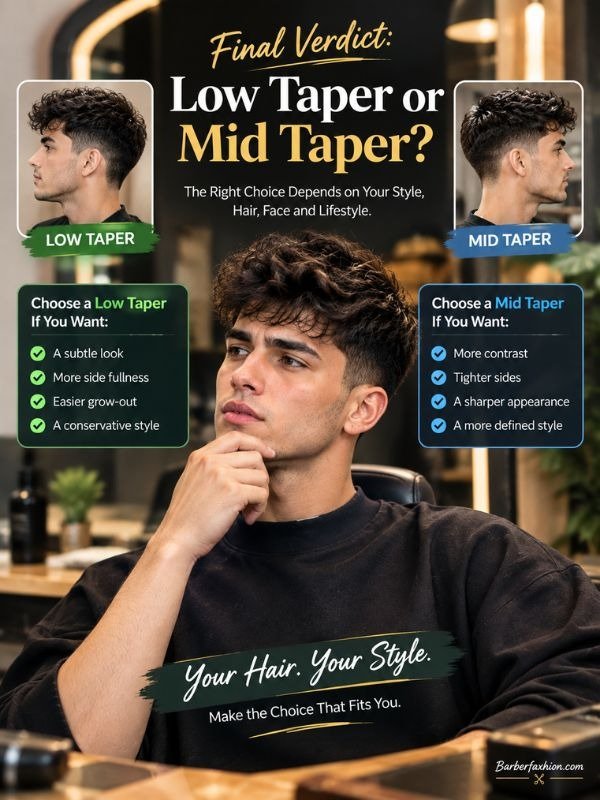
There isn’t a universal winner in the low taper fade vs mid taper fade debate.
Choose a low taper if you want a subtle transition, more side fullness, flexible styling, and a haircut that can grow out naturally. It’s especially useful when you want the top hairstyle to remain the main feature.
Choose a mid taper if you want stronger contrast, tighter-looking sides, and a more defined silhouette. It’s a good middle option when a low taper feels too subtle but a high taper feels too dramatic.
If you’re still unsure, start with the lower option and communicate your preferences clearly. Your barber can always adjust the placement at a future appointment.
Ultimately, the best taper is the one that fits your hair, face, lifestyle, and personal style rather than the one that’s simply trending.
Frequently Asked Questions
Is a low taper better than a mid taper?
Neither is universally better. A low taper is usually more subtle and keeps more side fullness, while a mid taper creates stronger contrast and definition. The better choice depends on your preferred appearance and hair characteristics.
Is a mid taper more noticeable than a low taper?
Yes. Because the transition sits higher, a mid taper generally creates a more visible change between the sides and the top.
Which taper is better for curly or straight hair?
Both can work with curly and straight hair. A low taper can preserve more natural side fullness, while a mid taper can create stronger contrast around the top. Your hair’s density and texture should guide the final choice.
Is a high taper more dramatic than a mid taper?
Generally, yes. A high taper moves the shorter transition farther up the sides, creating more contrast than a mid taper.
Can you change a low taper into a mid taper?
Yes. A barber can move the taper higher by removing more hair from the sides. However, once that additional hair is cut, you’ll need to wait for it to grow back if you later decide you prefer a lower placement.
Conclusion
The choice between a low and mid taper comes down to more than the name of the haircut. A low taper keeps the transition lower and the sides fuller, while a mid taper creates more contrast and a sharper outline. Your face shape, hair texture, density, top hairstyle, workplace, and maintenance preferences can all influence which one makes sense for you.
If you want a subtle and flexible haircut, start with a low taper. If you want a stronger definition without going all the way to a high taper, a mid taper can be the better fit. Most importantly, tell your barber exactly where you want the transition and how much side length you want to keep.