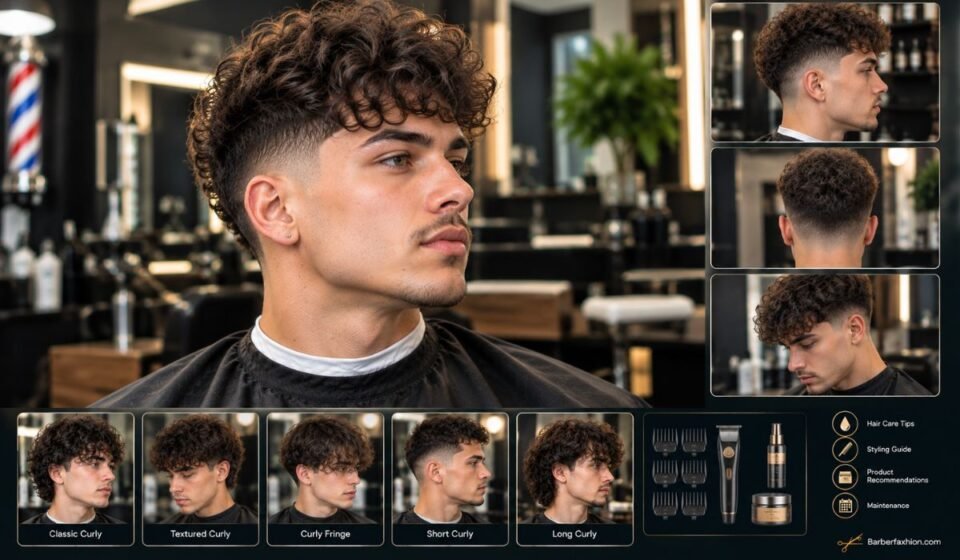

Curly hair already has plenty of personality, but the wrong cut can leave the sides looking bulky while the top loses its shape. A mid taper gives you a cleaner outline without taking away the curls that make your hairstyle stand out.
In this guide, you’ll find 17 modern styles, advice for different curl patterns and face shapes, what to tell your barber, plus simple styling and maintenance tips. Whether you have short curls, long curls, tight coils, or thick natural texture, you’ll know what to ask for and how to keep the cut looking sharp.
Quick answer: A mid taper fade curly hair style keeps the natural length and texture on top while gradually cleaning up the temples, sideburns, and neckline. It’s a good choice when you want a balanced, modern haircut without completely fading away the sides.
What Is a Mid Taper Fade on Curly Hair?
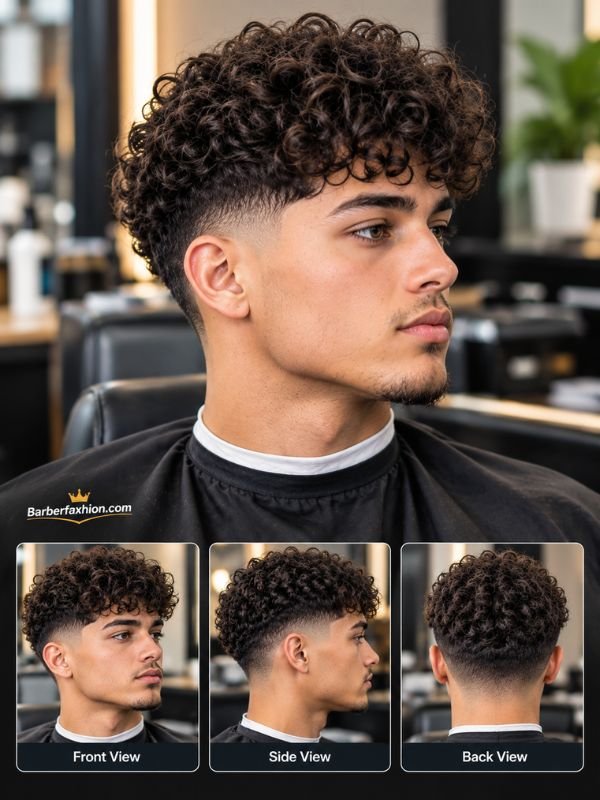
A mid taper gradually shortens the hair around the temples, sideburns, and neckline while leaving more of the sides and top intact. With curly hair, this creates a clean frame around your natural texture instead of removing too much of the volume that gives curls their character.
The exact result depends on your curl pattern, density, and top length. Tight curls can create a compact, defined shape, while loose curls can produce more movement and volume.
Mid Taper Fade vs. Mid Fade for Curly Hair
A mid taper and a mid fade aren’t quite the same. A mid taper fade focuses the shorter transition around specific areas such as the temples and neckline. A traditional mid fade usually carries the fade farther across the sides.
| Feature | Mid Taper | Mid Fade |
| Side coverage | More hair remains | More side hair is removed |
| Contrast | Moderate | Stronger |
| Curl volume | Easier to preserve | More reduced at the sides |
| Overall feel | Natural and versatile | Sharper and bolder |
If you want your curls to remain the main feature, a mid taper is usually the more conservative option.
Low, Mid, and High Tapers for Curly Hair
The main difference is where the taper begins and how much visual contrast it creates.
Low taper: The clean-up stays close to the ears and neckline. It’s subtle and works well if you want to preserve lots of side volume.
Mid taper: The transition sits higher around the temple area. It gives a noticeable but balanced shape and is one of the easiest options to adapt to curly hair.
High taper: The taper starts higher and creates a stronger contrast around the sides. It can make thick curls look more dramatic but removes more visual weight.
Is a Mid Taper Fade Good for Different Types of Curly Hair?
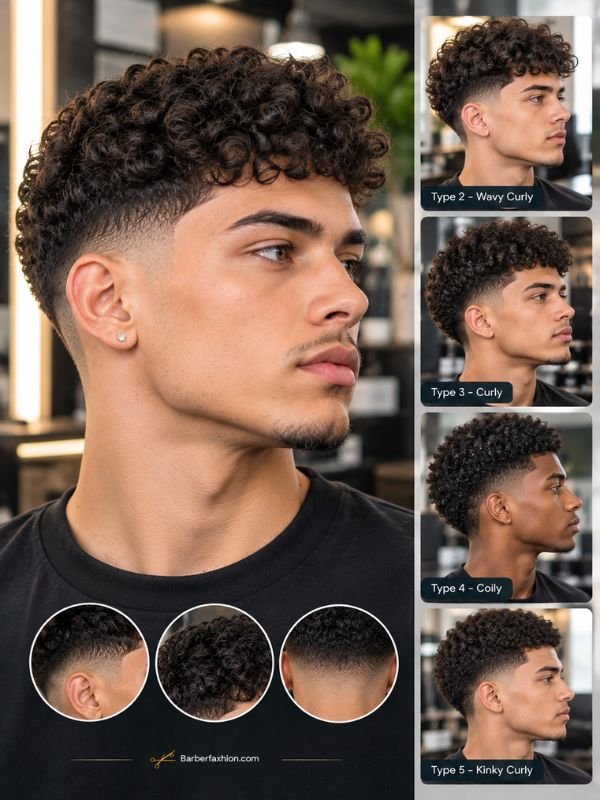
Yes, but the haircut should be adjusted to your actual curl pattern rather than copied exactly from someone else’s photo. Curl diameter, density, shrinkage, and top length can completely change the final appearance.
A good barber should look at how your curls sit naturally before deciding how much to remove.
Mid Taper Fade Curly Hair for Black Men
A mid taper can work especially well with dense curls and coily textures because it creates a clean perimeter while allowing the natural texture to remain prominent on top.
For tighter curls or afro-textured hair, the barber may combine the taper with a line-up, shaped top, sponge-defined curls, or a beard blend. The key is controlling the sides without making the transition so high that the natural shape disappears.
If you wear your hair longer, tell your barber how much volume you want to preserve. Don’t assume a reference photo will translate perfectly to your curl pattern.
Mid Taper Fade for Short Curly Hair
Short curls create a neat, low-maintenance version of the haircut. The shorter top makes the taper more visible, so even a small adjustment around the temples can change the overall shape.
This works particularly well if you want a clean everyday haircut without spending several minutes defining your curls every morning.
Mid Taper Fade for Long Curly Hair
Longer curls create more contrast between the clean sides and the textured top. You can leave enough length for a curly fringe, messy volume, pushed-back curls, or a more relaxed shape.
The longer the curls, the more important shrinkage becomes. Your barber should understand how much the hair contracts after drying before taking significant length off.
Loose Curls, Tight Curls, and Coily Hair
Loose curls: Keep enough length on top to show the curl pattern. A slightly longer top can create a relaxed, flowing appearance.
Tight curls: A shorter or medium-length top can make the curls look more defined and controlled.
Coily hair: Density becomes particularly important. The taper can clean up the perimeter while the top retains its natural fullness.
How Face Shape Changes the Best Curly Mid Taper
Your face shape doesn’t determine whether you can wear the haircut. It helps determine how you should balance the volume.
- Round face: Keep some height on top rather than creating excessive width at the sides.
- Oval face: Most curly taper variations work well because the proportions are naturally balanced.
- Square face: A textured top can complement the strong jawline without making the haircut too rigid.
- Oblong face: Avoid excessive height if you don’t want to visually lengthen the face.
- Heart face: Moderate side volume can help balance a narrower chin.
- Diamond face: Controlled width around the sides can complement prominent cheekbones.
15+ Best Mid Taper Fade Curly Hair Styles
The best version depends on what you want your curls to do. Here are 17 variations worth showing your barber.
1. Classic Curly Mid Taper
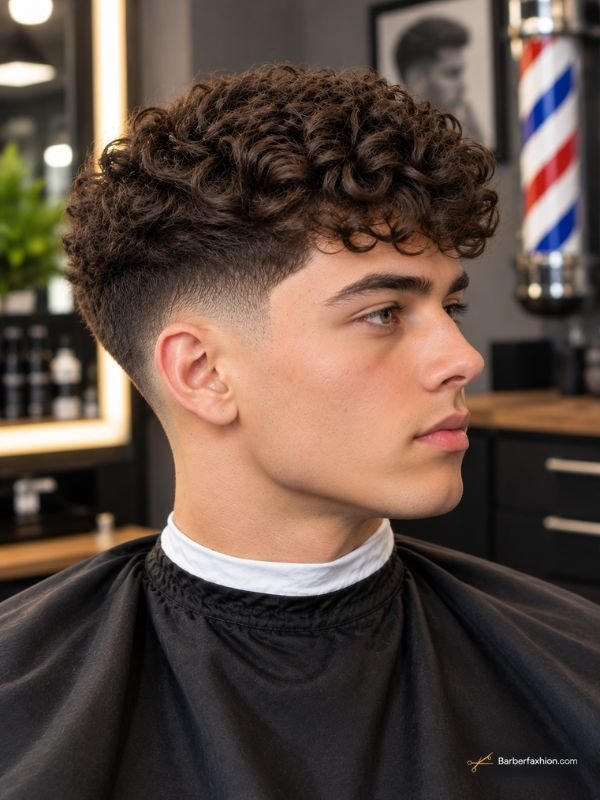
The classic version keeps the curly top natural while gradually cleaning up the temples, sideburns, and neckline. It doesn’t rely on an extreme contrast, making it easy to wear at school, work, or casual settings.
Ask for enough length on top to preserve your natural curl pattern. The barber can then shape the sides around your head rather than forcing the curls into a completely different silhouette.
2. Curly Mid Taper Blowout
A curly blowout adds noticeable height and volume to the top while the mid taper keeps the perimeter controlled. It’s a great choice if you like big, energetic curls rather than a close-cropped finish.
Use a lightweight curl product and diffuse the hair from underneath to build volume without aggressively disturbing the curl pattern.
3. Short Curly Mid Taper
This is one of the easiest versions to maintain. The short top keeps the curls controlled while the taper adds definition around the edges.
It’s especially practical if you don’t want to spend much time styling your hair every morning.
4. Curly Fringe with Mid Taper
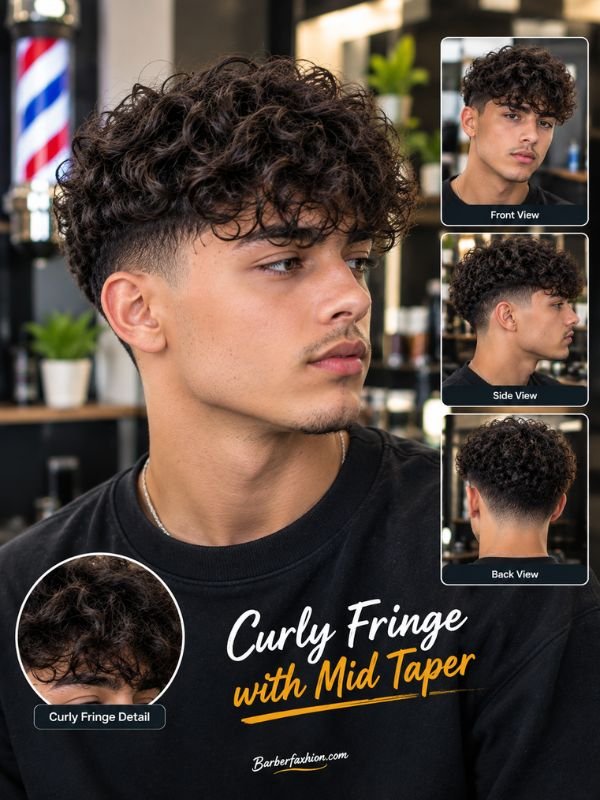
Letting the curls fall slightly toward the forehead gives the haircut a younger, more textured appearance. The fringe doesn’t have to be perfectly straight or symmetrical.
Ask your barber to account for shrinkage before cutting the front. A curly fringe can become much shorter after drying.
5. Curly Crop with Mid Taper
A curly crop keeps the top relatively compact and textured. The mid taper adds a cleaner outline without turning the haircut into a full skin fade.
This is a strong option if you want definition without excessive height.
6. Curly Quiff with Mid Taper
For more height, push the curls upward and slightly backward while keeping the taper controlled around the sides. This creates a more polished version of the curly haircut.
A lightweight mousse or curl cream can provide movement without making the hair feel stiff.
7. Curly Mullet with Mid Taper
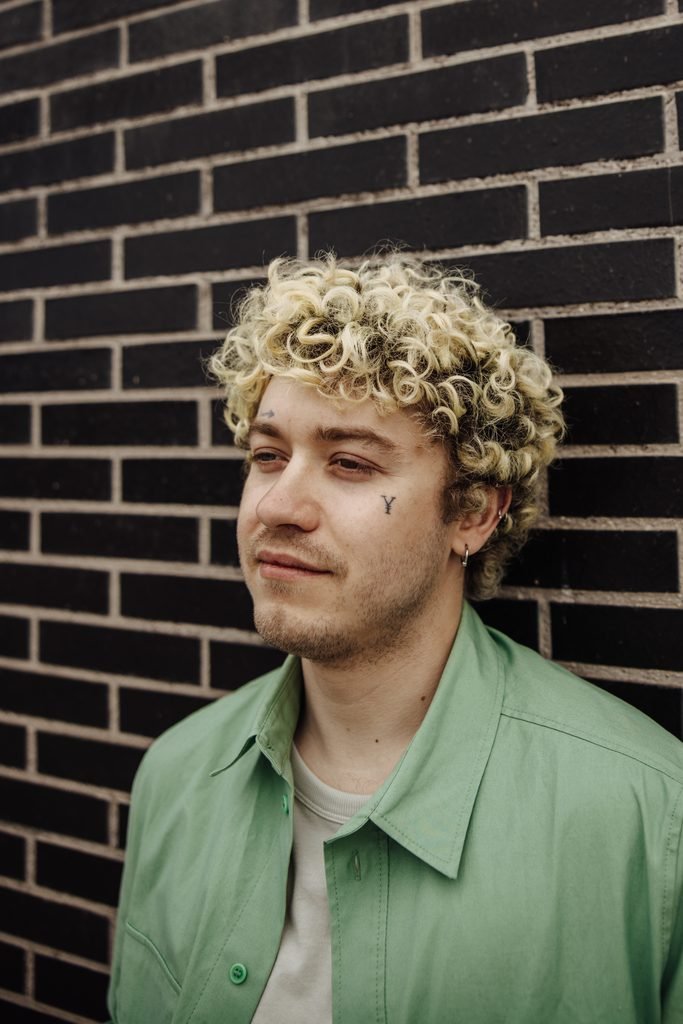
A curly mullet combines shorter sides with extra length toward the back. The mid taper gives the temples and sideburns a cleaner transition while the curls provide the personality.
This is a better choice for someone who wants a more fashion-forward haircut rather than a conservative everyday style.
8. Textured Curly Top with Mid Taper
Instead of defining every curl individually, this version focuses on texture and natural separation. The top looks slightly messy while the sides remain controlled.
It’s ideal if you like a relaxed hairstyle that doesn’t look overly styled.
9. Messy Curly Mid Taper
The messy version embraces imperfect curls, uneven texture, and natural movement. You don’t need every curl to sit in exactly the same position.
Use a small amount of product, scrunch it through damp hair, and let the curls settle naturally.
10. Defined Curls with Mid Taper
For a cleaner appearance, use a curl cream or gel to make individual curls more visible. The taper provides the sharp perimeter while the defined curls create contrast on top.
This style works best when the hair has enough moisture to prevent the curls from becoming dry and frizzy.
11. Long Curly Top with Mid Taper
Longer curls make the taper more noticeable because of the difference between the clean sides and fuller top.
You can wear the curls forward, backward, or naturally to one side. Just remember that longer curly hair needs more attention to hydration and detangling.
12. Mid Taper with Tight Curls
Tight curls create a compact, textured finish. The taper cleans up the areas around the ears and neckline without forcing the top into a completely different texture.
For dense hair, your barber may need to remove some side bulk while carefully preserving the shape of the top.
13. Mid Taper with Natural Volume
If you don’t want a highly defined or sculpted hairstyle, keep the curls natural. Let the top retain its volume and movement while the taper handles the messy-looking edges.
This is one of the easiest options for people who prefer a low-effort routine.
14. Mid Taper with Line-Up
Adding a line-up gives the haircut a sharper finish around the forehead and temples. It works particularly well when you want more definition around naturally curly or coily hair.
Don’t ask for an unnaturally straight hairline. Your barber should work with your natural shape.
15. Mid Taper with Beard Blend
A beard blend connects the haircut and facial hair into one continuous look. The taper can transition around the sideburn area into the beard without creating an obvious gap.
This works particularly well with dense curly hair because the beard adds another layer of texture.
16. Mid Taper for Coily or Afro-Textured Hair
With coily hair, the top can retain substantial natural volume while the taper gives the edges a cleaner appearance.
You can combine it with a line-up, short sponge curls, a shaped top, or a longer natural afro-inspired finish.
17. Mid Taper with Curly Top and Beard
For a fuller, more mature appearance, keep the curls relatively substantial and pair them with a neatly shaped beard. The taper creates the transition between the two.
The trick is keeping the beard and haircut balanced. If both are extremely bulky, the face can look visually crowded.
Mid Taper vs. Other Taper Fades for Curly Hair
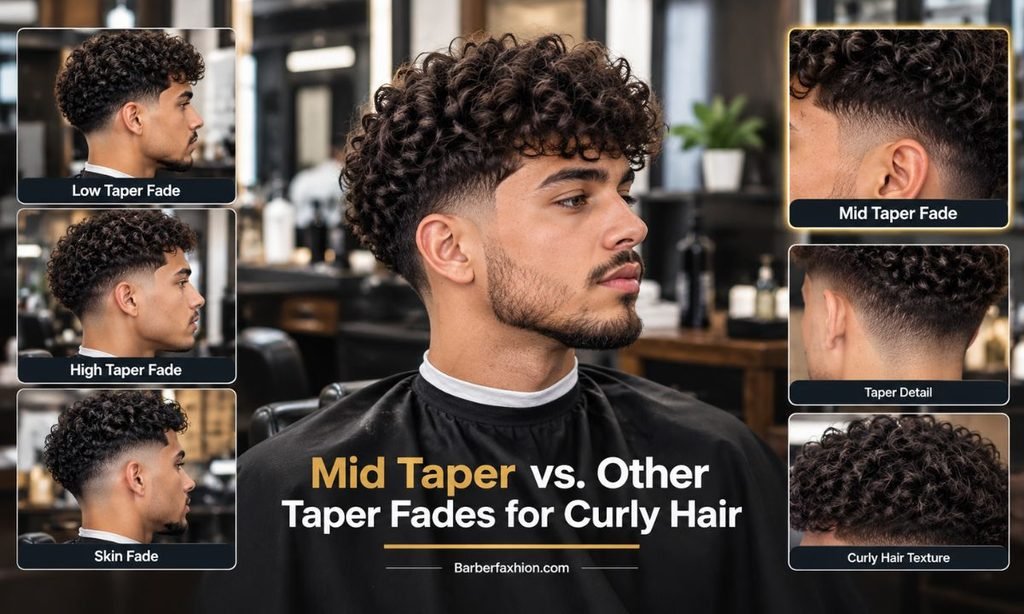
Choosing the right taper comes down to how much side volume you want and how much contrast you’re comfortable with.
Mid Taper vs. Low Taper for Curly Hair
A low taper leaves more hair around the sides and creates a softer transition. It’s a good option when you want your curls to dominate the overall silhouette.
A mid taper creates more visible cleanup around the temples and gives the haircut a slightly sharper appearance.
Mid Taper vs. High Taper for Curly Hair
A high taper creates stronger contrast because the shorter section starts higher. It can make a curly top look more dramatic.
A mid taper sits between subtle and aggressive. If you’re unsure which direction to take, it’s often the easier starting point.
Mid Taper vs. Mid Fade for Curly Hair
A mid fade generally removes more hair from the sides than a mid taper. This creates a sharper transition and makes the curly top stand out more strongly.
Choose the taper when you want more natural side coverage. Choose the fade when you want stronger contrast.
What Should You Ask Your Barber for?
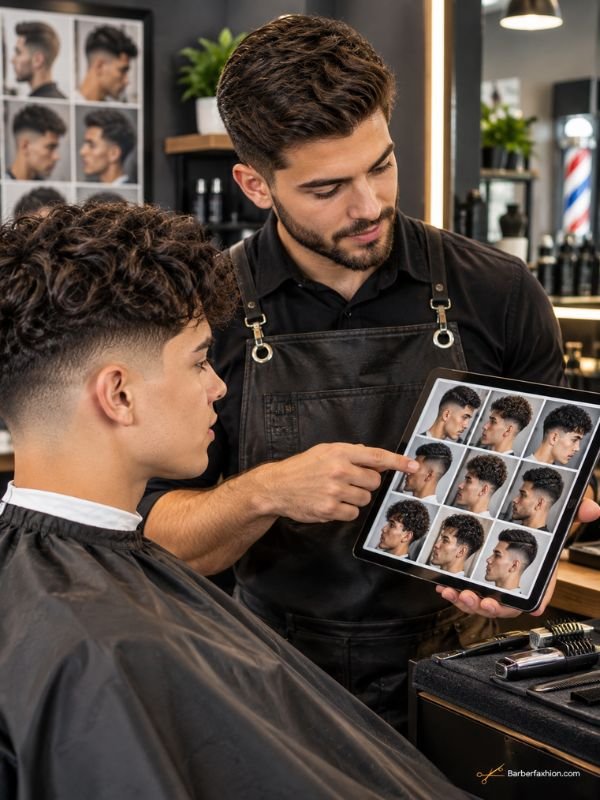
Don’t rely only on saying, “Give me a mid taper.” That leaves several important details open to interpretation.
Show a Reference Photo
Bring one or two photos showing a curl pattern and hair density reasonably close to yours. A photo is particularly useful because the word “curly” can mean anything from loose waves to tight coils.
Say Where the Taper Should Begin
Tell your barber that you want a mid-position taper around the temples and neckline. If you prefer a softer appearance, say so before the clippers come out.
Decide How Short the Bottom Should Go
You can choose a softer shadow finish, a short clipper finish, or a much closer skin finish.
You don’t automatically need the skinniest possible finish. A softer bottom can make the haircut look more natural as it grows out.
Explain How Much Curl Length You Want to Keep
This is one of the most important conversations for curly hair. Tell your barber whether you want to preserve maximum length, moderate volume, or a shorter defined top.
Remember that curls shrink after drying.
Discuss Bulk, Fringe, and Neckline
Tell your barber where you want the volume. You might want more fullness on top but less around the temples.
Also discuss whether you want a rounded, natural, or cleaner neckline.
Barber Script You Can Use
You can say:
“I want a mid taper around the temples and neckline. Keep the curls on top and don’t take too much length away. I want the sides cleaned up but still want some natural volume. Please account for how much my curls shrink when they dry.”
If you want a line-up, beard blend, curly fringe, or specific top length, mention that separately.
How to Style a Mid Taper with Curly Hair
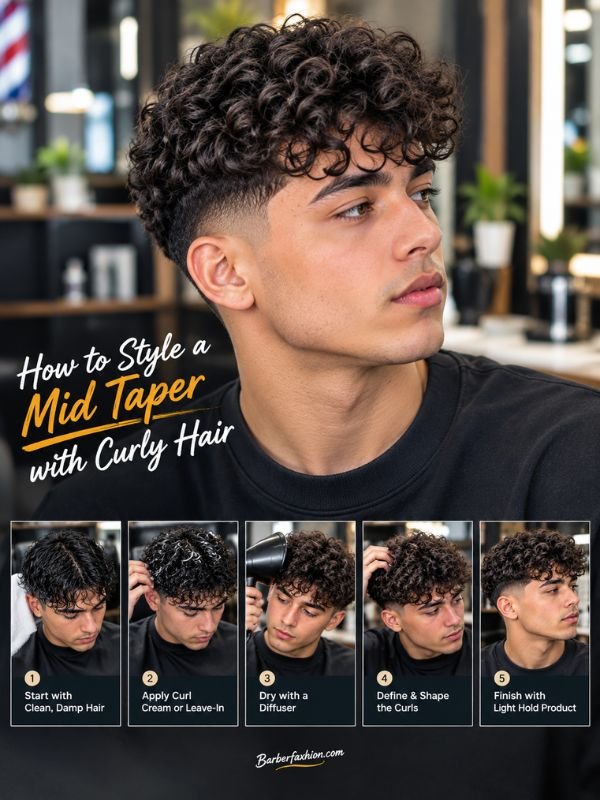
The taper itself is easy to maintain. The curls are where your daily routine matters most.
Start With Damp, Detangled Hair
After washing or refreshing, gently detangle your hair while it’s damp. Avoid aggressively brushing dry curls because it can disrupt the curl pattern and create unnecessary frizz.
Use your fingers or a wide-tooth comb when appropriate for your curl type.
Add Moisture and Curl Definition
Apply your chosen styling product to damp hair. A leave-in conditioner can provide moisture, while curl cream can help shape the curls.
For stronger hold, a small amount of gel can be added after the curl cream.
Start with less product. You can always add more.
Air-Dry or Diffuse Without Flattening the Curls
If you have time, air drying is simple. If you want more volume, use a diffuser on a gentle setting.
Avoid constantly touching the curls while they’re drying. The less you disturb them, the easier it is to keep their natural shape.
Refresh Curls Between Wash Days
You don’t always need to completely wash your hair to bring the style back.
Lightly dampen the curls, add a small amount of leave-in or curl product if needed, and gently scrunch them back into shape.
Products That Work Best for Curly Hair
Your ideal combination depends on your curl type and desired finish.
| Product | Best for |
| Leave-in conditioner | Moisture and softness |
| Curl cream | Definition with flexible movement |
| Mousse | Light volume |
| Gel | Stronger hold and definition |
| Hair oil | Small amounts for finishing or moisture support |
Don’t pile several heavy products onto the hair just because they all promise curl definition. Too much buildup can make curls look heavy and dull.
How to Maintain a Curly Mid Taper
A good haircut can lose its shape quickly if the perimeter grows out unevenly.
How Often Should You Get a Taper Touch-Up?
Many people prefer a touch-up every few weeks, but there’s no universal schedule. Faster-growing hair may need cleaning sooner, while someone who likes a softer grown-out appearance can wait longer.
Your goal is to maintain the shape you actually like rather than following an arbitrary calendar.
How to Keep Your Curls Healthy
Curly hair can become dry more easily because natural oils don’t always travel down the bends of the hair as easily.
Use a routine that suits your hair rather than washing aggressively every day. Keep the hair moisturized and avoid rough towel drying.
Avoiding Frizz, Dryness, and Excessive Side Bulk
Use gentle handling when the curls are wet. Avoid constantly combing or brushing them once they have formed.
As the taper grows out, watch the temple and sideburn areas. That’s usually where the clean shape starts disappearing first.
Why Dry Length Matters With Curly Hair
Curly hair can appear considerably shorter once it dries and returns to its natural curl pattern. That’s why cutting based only on how long the hair looks when wet can produce an unexpectedly short result.
If you’re growing your curls, tell your barber how you normally wear them and how much length you want to preserve.
Common Mid Taper Fade Mistakes to Avoid
Taking the Taper Too High
A taper that climbs too far can start looking more like a high fade. If your goal is to keep side coverage, be clear about the placement.
Cutting Too Much Curl Length
It’s easy to underestimate how much curly hair will shrink. Don’t let the top get shortened dramatically unless that’s actually the look you want.
Ignoring Hair Shrinkage
Always consider the dry curl pattern. The haircut should be designed around how you normally wear your hair.
Removing Too Much Side Bulk
Some side volume is useful for curly hairstyles. Removing everything can make the top appear disproportionately large.
Using the Wrong Products or Overloading the Hair
Heavy products can weigh down curls, while too much gel or cream can leave buildup. Start with a small amount and adjust based on your hair’s response.
Choosing a Reference Photo With a Different Curl Pattern
A haircut can look completely different on loose curls compared with tight coils. Find a reference that’s reasonably close to your own texture and density.
Who Should Consider a Mid Taper—and Who Might Prefer Something Else?
Choose a Mid Taper If You Want:
- Cleaner temples and neckline
- Natural curls on top
- Moderate contrast
- A versatile modern haircut
- Less side bulk without removing everything
- A style that can work with short or long curls
Consider a Low Taper or Another Style If:
- You want maximum side volume
- You prefer a very subtle transition
- You don’t want a noticeable contrast
- You want to stretch the time between touch-ups
- Your sides are naturally thin and you don’t want them exposed
A mid taper isn’t automatically better than a low or high taper. The right choice depends on the shape you want your curls to create.
FAQs
Is a mid taper fade good for curly hair?
Yes. A mid taper can clean up the temples, sideburns, and neckline while keeping the natural curl pattern and volume on top.
What curl types work best with a mid taper fade?
Loose curls, tight curls, and coily textures can all work with a mid taper. The barber should adjust the amount of side bulk and top length according to your density and shrinkage.
How do I ask my barber for a mid taper fade with curly hair?
Tell your barber you want a mid taper around the temples and neckline, then explain how much curl length and side volume you want to keep. A reference photo that matches your curl pattern can make the request much clearer.
How often should curly hair get a mid taper fade?
It depends on how quickly your hair grows and how clean you want the taper to look. Many people prefer regular touch-ups, while others let the taper grow out for a softer appearance.
Is a mid taper better than a low taper for curly hair?
Neither is universally better. A mid taper creates more visible structure around the temples, while a low taper keeps more side coverage and gives a softer finish.
Conclusion
A mid taper fade curly hair style gives you a useful middle ground: clean, controlled edges without sacrificing the natural texture and volume that make curly hair look good. The best version depends on your curl pattern, density, face shape, top length, and how much contrast you want.
Before your next appointment, bring a reference photo, explain where you want the taper to sit, and tell your barber how much curl length you want to preserve. When the taper is shaped around your natural curls instead of fighting them, the result is easier to style and much more personal.